August 16, 2023
I. Epistemological assumptions
How does one test astrology? How does one find the astrological characteristics of a newly discovered body in the solar system? How one envisions astrological research depends on what one thinks Astrology is, and more fundamentally, on one’s epistemological assumptions.
Phenomenology
One usually thinks of ‘reality’ as the sum total of phenomena, the totality of what is existing independent of the observer. But reality conceived this way is not an experience. To experience it, there must be consciousness, which I understand as the inner, subjective processing and elaboration that entails the perception of these phenomena. Therefore, the word reality, as I understand it, always refers to a phenomenon of consciousness, and is a social construct, since consciousness is contingent upon culture. Consciousness is re-creating reality all the time through a selective process that always involves subjective classification and interpretation.
Astrology has a boundless capacity to measure and to establish order in the reality we experience, or into what seems unmeasurable and disordered as it comes to our consciousness. This unlimited capacity comes from the use of celestial mechanics to construct the models with which astrology works, the ‘schemes’ we invent to classify and order ‘reality’, and which, because they are a product of the human mind and consciousness, become very difficult to elucidate. We as astrologers don’t see the scheme because it is inside of us, because it is with the scheme that we are ‘seeing’, and we cannot see our own eyes.
Astrological signatures
Any moment of time, or rather, certain very significant (for our consciousness) moments of time, contain in themselves –like an artistic painting or a well elaborated scene in a movie– a revelation of the past and of the future through their ‘signature’ or ‘physiognomy’ (appearance) in the present. People’s faces and gestures are like that: they are constantly revealing the past history and the future potentialities or ‘promises’ of an individual. With astrology and the high level of abstraction of its tools and techniques, based on mathematics, we model this reality, this whole ‘history’ contained in a fleeting moment of time.
If we were able to read this signatura rerum by ourselves, if we could ‘hear’ how things and beings or moments talk to us in revelation, if we could understand this language, there would be no need for the abstractions of astrology at all. But curiously, the continuous practice of astrology combined with long experience in ‘listening’ or ‘reading’ the people who come for consultation, can develop this ‘ear’, so that, happily and paradoxically, astrology can transcend itself and the mind can get rid of the strict and limiting mathematical structures and a priori classifications of astrology, which then become an obstacle for real knowledge.
Astrology as language
In this sense astrology is very similar to language, and the continuous practice and internalization of the astrological language is a mental exercise that has definite effects upon consciousness. Astrology has its own rules of thought, its own logic, and its practice releases creative faculties of the mind that sharpen perception and make possible the disciplined development of the imagination. Because of its analogical character and its complex system of correspondences, which the astrologer employs as a function of his or her imaginative abilities, experience and thought are intercalated, and as a result unsuspected relationships begin to appear that open the door to a transformation of reality.
Every time we make an astrological (or any type of) interpretation, we are re-creating the world, re- creating reality with the elements that the particular cognitive techniques we are using provide. Astrology, through its different or alternative modelling schemes, helps consciousness establish through the use of language the common elements, the structural and semantic similarities between things, the ‘common trunk’ between different phenomena in human consciousness. Doing this, it is able to break the physical and temporal separations of the physical world, and can connect the inner world of consciousness with the outer phenomenological reality. This is only possible because of language, which builds a complete dialectical system of the world, such is poetry, psychoanalysis, and all the human endeavors –including Science– that are possible thanks to the nature of language and of the human imagination.
II. Modelling and validation
There is no way of modelling from the point of view of the known laws of physics the elaborated gamut of correlations between astrological elements and ‘reality’ or ‘experience’ that are postulated by Astrology, mainly because most of these astrological elements have no physical existence at all (e.g. house meanings, 30-degree signs, transits to a birth chart, rulerships, etc.), but also because the typical correlations with astronomical and astrological factors are analogical relationships that can exist only by way of metaphor.
Apriori Relationships
Empirical evidence is important to validate Astrology, but astrological symbolism is not dependent on it. For example, many planetary characteristics are derived from orbital symbolism and the simple ‘naive’ analogies that it generates, such as the slow motion of Saturn = old age and wisdom, etc. Astrology is not based on any sort of empirical relationship between one thing (e.g. a person) and the other (an astrological signature), but in an interpretation of one thing in terms of the other. The astrological mapping establishes the relationship a priori, not ’empirical evidence’. Once this relationship is established by means of the conventional rules of astrology, we re-create reality by means of language and interpretation based on metaphors. This is what we always do as astrologers.
Astrology does not describe circumstances, it says things about them, so the actual circumstances may always be very different and they don’t really matter; what matters is what you can say about them, our interpretation of their meaning in terms of what the chart is saying. This ties with what I said about a ‘signature’, in reference to “the signature of things”. The signature is established by whatever conventional, a priori rules one uses. This signature does not refer to the outer circumstances or appearance. No matter how different circumstances may be, if they share the same astrological signature they are related. The mapping establishes that two things are related as a result of applying a specific a priori system of classification. The relationships are all there because classification systems are structured. What must be tested is one’s operationalization, explanation, or interpretation of the specific relationship.
This is where Astrology differs from other disciplines: Astrology tells you a priori that the relationship is there. This never has to and cannot be tested (which saves you a lot of work!). The only thing that can be tested is the interpretation or particular operationalization of the apriori relationship that Astrology provides. The astrological mapping directs the mind to make the analogy, and the astrological association is established by means of symbolism. We do this all the time in everyday life and in the scientific interpretation of data, except that it is so ingrained and conventional that we are not aware of it.
Testing
The critical point, then, is the question put for testing. Basically, since we are dealing with the meaning of an astrological body or element or signature, in practice we will be testing the act of interpretation, i.e., a particular use of a particular language and meaning in a particular context. And since language usage is always a result of context, I, personally, doubt that it can ‘tested’. I think that the only thing ‘testable’ is the method used to derive the results, not the results themselves. Here ‘testing’ means a critical examination of the methodology used to produce the ‘interpretation’ or ‘operationalization’ of the relationship that was used to produce the result. The result cannot be tested.
For example: someone may gather a large amount of data or evidence to support the notion that the quintile is a strong aspect and that it means such an such. But for each and every case piled up with ‘strong’ quintiles, I can make a case where what is ascribed to the quintile is the result of something else, because it is all a matter of interpretation based on language, it is a matter of what you think a priori the quintile and the planets involved are representing. For this reason, that the quintile is ‘strong’ can never be tested. It can only be demonstrated through examples. A demonstration is not the same thing as a ‘scientific’ test. A demonstration is an illustration of how a particular tool (i.e. the quintile) can be used meaningfully and can be useful in a particular context.
One does not test a language or a code. One just learns to use it meaningfully and effectively. Astrological research is about the disciplined construction of a language or code, not the testing of a scientific hypothesis. Critical analysis is applied mainly to the method used to furnish the classification, i.e., to establish the semantic nuclei from which one derives an astrological interpretation, or in other words, how the concept ‘strong’ is going to be measured or evaluated, not if it the quintile is strong or not.
III. The bias of physics
There is a strong physical bias when it comes to doing astrological research or astrological ‘testing’. Attempts are made to perform ‘scientific tests’ ignoring completely the many a priori assumptions that are being made in the design of the test itself, and ignoring that the subjective pre-conception of what astrology is or should be is dictating the nature of the test and the interpretation of the results, in an obsession to ‘find proofs’ based on prejudiced notions of what would be a ‘scientific validation’. Sociology, Anthropology, Linguistics, Cognitive Science, have methods of validation which differ from those of physical science, and they are summarily ignored. As long as they are ignored, in my opinion, all such studies are futile.
Any study that pretends a direct real-time in-situ relationship between people and celestial objects or events is ignoring the fact that astrology never, or almost never, works that way, and as a consequence adds nothing to the understanding or public acceptance of astrology. Attempts to ‘validate’ astrology in terms of mainstream science are doomed to failure because they are based on assumptions and beliefs which are in contradiction with what astrologers actually do and the nature of the tools they use.
Clocks and calendars are found in nature only metaphorically. The calendar and the clock, like astrology, are human inventions, they are tools and not objects of knowledge and they cannot be ‘observed’. Everything that happens in the phenomenal world can be modelled by means of these human devices, but you will nowhere find in nature the internal machinery of a clock or the spatial relationships with which a calendar measures and classifies time. Astrology’s main characteristic is an artificial, anti-natural, purely abstract, ‘freezing’ of time (a radix, a chart), and nature doesn’t work that way. And it is made of a priori classification schemes: you will find nowhere in the sky 30 degrees of ‘cardinal fire’ next to 30 degrees of ‘fixed earth’.
Astrologers work with abstract mathematical coordinates that are independent of real events happening in the sky at the time to which these coordinates refer (e.g., transits, progressions, directions, even the radix chart itself), and these coordinates are plotted against cultural classification systems (signs, houses, dignities, aspects…) that have been geometrically modeled after celestial motions but which do not exist in nature.
Heuristic devices
The structures active in socio-cultural reality are metaphorical models and interpretations, ‘heuristic’ devices. Astrology is like a matrix that furnishes such interpretations, or guides the mind in making them. This is why it is not necessary to ‘prove’ anything. There are multiple ways of explaining things, and each way, each astrological model (the different techniques) has its own properties and deficiencies in terms of what it can show about the reality which is subject to astrological analysis.
Each astrological pattern can manifest in at least dozens of ways in real life and in many different and apparently unrelated circumstances. The corresponding pattern in real life is never observed or observable, but is the result of an interpretation. It cannot be measured. As in social or cultural phenomena: you can device any number of ways to ‘order’ the phenomena and find patterns or hypothesis to explain out the phenomena, but you can never ‘prove’ any of them.
There is a difference between doing astrological research and devising a test in order to ‘prove’ something. It is the last one that I think is very deceptive and futile. The problem here is that both the ‘test’ (the hypothesis) and the analysis of the results at any point is an interpretation, and is by necessity biased, while many things cannot be tested, such as occurrences in the past and complex situations that cannot be reproduced or isolated. This is why models are necessary. A model is a structure, a particular way of organizing data; we can ‘test’ a model, but we cannot ‘prove it’ because there is nothing to prove. The model has to be tested for consistency, effectiveness, usefulness, and statistical ‘success’.
Sampling and statistics
It is common to see astrologers trying to gather data for their ‘research’. I don’t think there is anything wrong with that, on the contrary I am convinced it is an essential and necessary area of Astrology. The problem is when the research is labelled ‘scientific’ and the methodological procedure is taken for granted without any discussion. Often one finds that the project is being called ‘scientific’ simply because it is based on the statistical analysis of large quantities of data, but the problems involved in isolating the factors or selecting the data to be analyzed and in interpreting the results are ignored and an arbitrary set of unspecified assumptions constitutes the basis of the study.
In research there is always an a priori selection of data based on certain assumptions that are ideological and subjective. The process of selection of what to ‘examine’, or how to qualify and quantify the data available and where, when, etc., is entirely dependent on the particular ‘reality construct’ we have created in our mind through the process of learning. Then comes the interpretation of those qualities and quantities, the meaning one gives to the data, which is the result of that same learning process. Empirical research is built upon a specific theory of knowledge, it is not independent of it. Epistemological assumptions are determining the whole process of empirical research except the number crunching.
For example, one such epistemological presumption is the concept of ‘event’. It is often assumed that astrology deals with or is about ‘objective’ events, instead of, for example, the significance of those events; but the concept of ‘event’ is purely subjective, because what is an event for you may not be for me, living in another part of the world, in another culture, and with a different history and cognitive structure. Additionally, when dealing with ‘events’ one is always dealing with their interpretation according to a particular set of conventional and largely unconscious criteria. In all this, epistemological assumptions are determining the whole thing.
IV. Gauquelin
Consider for example the Gauquelin studies. They relate exclusively to natal astrology, and evidence his obsession with finding causal bio-physical explanations based on metaphors such as ‘biological imprints’ and ‘planetary heredity’. The validity of the statistical correlations he found between some planets and character or profession is not in question, neither that his findings seem to confirm the doctrine of angularity or of the specific action of some planets. But he based all his work on a very arbitrary and questionable premise: that the planet-to-person/character/profession statistical correlation implies a physical-biological connection.
By excluding completely the horary and mundane branches of astrology that contradict this physical/biological premise (is it necessary to explain this?), the results of Gauquelin leave the door open for further investigation of the Man/Cosmos relationship, but add little to the understanding or elucidation of how or why Astrology works.
Why is there such a prejudice among astrologers in favor of a statistical approach to research? Are statistics necessary? What other methods are there for obtaining universally valid results? Why is there such a prejudice that for a hypothesis to be valid it has to pass a ‘scientific’ test? What does the term ‘scientific’ mean? Why are the numerous contributions to the theory of knowledge coming from the social and cognitive sciences ignored so often by astrologers wishing to embark on research? What do statistics show? What do they not show? What is the difference between an astrological fact or event and a physical and biological fact or event? Why are these questions so rarely (if at all) addressed by astrological researchers? How can astrological factors be isolated in order to do research on them? How many ways of doing this are there? How is knowledge validated socially? What exactly are we going to test? How do I test a language? How are we going to ‘test’ that the name pencil ‘means’ the ‘thing’ pencil? How do we test meaning? How do I test a convention? Does a convention need to be tested?
How can a serious research be launched if these questions are not addressed first!!!
Scientific models
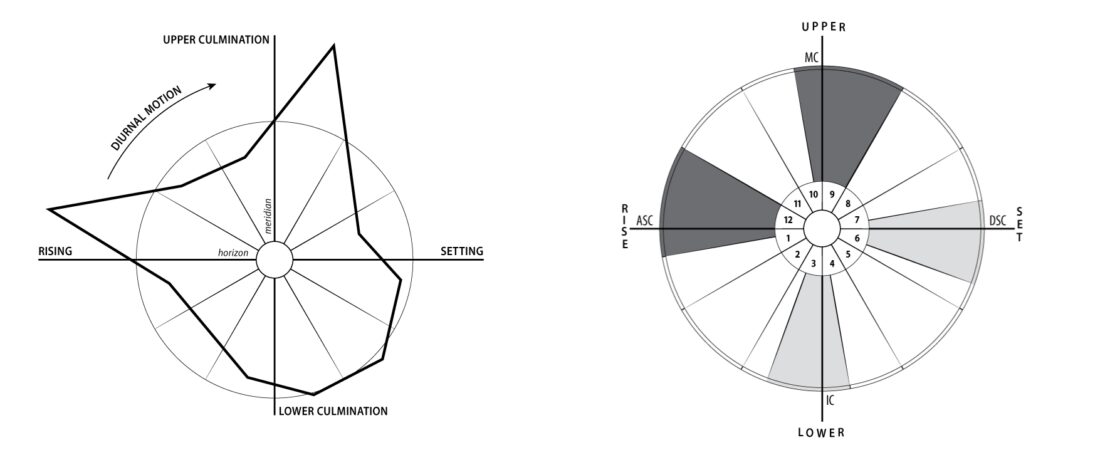
Gauquelin’s results involve some discrete house positions of the planets at the moment of birth –we may consider these discrete positions a phenomenon of nature. This natural phenomenon is found to be statistically correlated to profession and/or vocation, and we may call this correlation “an astrological phenomenon”. Up to this point, all we can say is that there is statistical evidence of something that can be called “an astrological phenomenon”, but:
1) there is no “scientific” evidence of anything because no scientific model or explanation has been tested, let alone proved, by means of this correlation.
2) there is nothing that warrants the assertion that this correlation is a phenomenon of nature, except a simple hypothesis for which no physical or biological testable model exists.
Gauquelin proposed a “planetary heredity” biological explanation to account for the correlation, but never went beyond that point. There is no model or experiment to prove or disprove this explanation, i.e., he never operationalized the hypothesis or put it to test. So Gauquelin’s statistical results are not scientific evidence of anything, because no scientific model existed in the first place, and they are not evidence that astrological phenomena “exist in nature”, as long as nobody knows what these “phenomena” could be, i.e., there is no physical or biological tested model or theory that shows how the planet’s position is related to vocation or profession.
Biological and “causal” are not the same. Note that I never mentioned the word “causal”, I used the word “model”. Without a testable model based on sound natural science principles, there is no natural science.
A significant statistical correlation between two variables, without a model that explains how the two variables interact, does not constitute “scientific evidence”. Evidence of what, if there is nothing “scientific” being tested in the first place? There is nothing physical per se, nothing that belongs to the world of nature, in a planet’s position at the moment of birth correlated to a choice of profession. The planet remains an abstract mathematical point on a graph, or a point of light in the sky (or not even that if it is below the horizon), UNTIL a testable (physical or natural science) model is proposed that explains the relationship between the planet and the choice of profession. In the absence of such a physical model, the correlation belongs to the realm of numerical (mathematical) and social constructions, not to the world of natural phenomena.
Psychology and Medicine provide explanatory models of every phenomenon they test for statistical correlation, whether it is physical or not. Gauquelin provides none, we are left in the dark about how the planets are related to choice of vocation, except for an unmnodelled untestable hypothesis labelled “planetary heredity”. This is not “scientific proof” by a very long stretch. The only thing that Gauquelin’s correlations “prove” is that there is a correlation, but the nature of the two variables and of their mutual relationship is left unexplored in their philosophical and epistemological implications. It is absurd to believe that an empirically demonstrated statistical correlation and an untestable unmodelled hypothesis constitutes “scientific proof”. Proof of what?
Natural Science
There is nothing physical per se, nothing that belongs to the world of nature, in a planet’s position at the moment of birth correlated to a choice of profession. Additionally, a map of the artificially frozen moment of birth is not “the newborn”. It is impossible to physically model the newborn into the equation. What we have is a chart of an artificially frozen moment that is used as a symbol of the newborn, and this has nothing to do with Science nor with nature. It is entirely a product of the human brain.
And the planets? All we have is a bi-dimensional (sometimes) or unidimensional (most often) angular coordinate that represents the planet. Neither the planet nor the infant can be modelled physically speaking because the physical link between them is completely unknown, and you cannot model the unknown, all you can do is use a symbolic or linguistic referent to it; and a birth chart is not “us”, it is only a frozen picture of the moment we were born that we use and manipulate by means of analogies AS IF it were us.
The object of astrological inquiry cannot be understood without its context. Every astrological meaning is by necessity an interpretation made by the astrologer of the object in its context. The only thing that can be put to test in Astrology is a specific meaning produced by the astrologer and deprived of its context, and this has nothing to do with Science, it is more a matter of linguistics or semiotics. Meanings can be evaluated or socially validated, but they can never be “proved” in the manner of physical Science.
The problem here lies in our assumptions. It is very common to assume that astrological phenomena belong in the world of nature, but it is easily demonstrable and proved that they don’t, so what many think is “rock solid” evidence of astrological phenomena is not really Astrology at all. There is actually very little in the mathematical and social constructs that today are called “Astrology” that can be found in the world of nature. Astrology as it is practiced today is a technology, a set of tools, not a phenomenon of nature.
A lot of consfusion arises when we don’t pay attention to the nature of the tools we use. We can define “Astrology” a priori any way we want, and the result will be as many definitions as there are astrologers. But if we examine what an astrologer does, or has been doing since the time of the Greeks (horoscopics), this problem disappears and we would have a pretty clear idea of what Astrology is and is not on which we could all agree.
Metaphor
To summarize: Astrology per se can never be tested in modern scientific terms because there is nothing there to test. There is no physical model, no physical causal hypothesis, there is nothing physical that can be tested. What is being tested is what astrologers say, their delineations, the interpretation they make of various astrological combinations or patterns, which is most of all a linguistic construction that has very little to do with physical science.
The correlation of certain “astrological meanings” and some concensus previously established reality construct or “event” is not with the real planets in the sky but with what an astrologer interprets from the combinations in a simplified map of an event that happened a long time ago (the birth).
Additionally, an astrological chart is not a map of the heavens, but a map of something else (a person, an event, an interrogation, etc.). The planets do not speak of themselves, but about you, or me, or the war in Iraq. In other words it is a metaphor because we use one in substitution of the other, e.g., “the chart is you”, “my” chart or “my” Moon, “the chart of a nation”… the planet does not say things about itself, but about something or someone else.
Without the intermediation of metaphor there would be no Astrology. The connection between astrological chart or astrological sky and events on earth or in people’s lives can only be established by way of metaphor.
What can be seen in studies such as that of the Gauquelins, from the astrological point of view, is the disciplined construction of a language or code, not the scientific testing of an astrological hypothesis. The distinction is established not by the methods applied to the data, which are or may be all scientific, but by the arbitrary a priori selection in the process of collecting the data. This a priori selection is based on certain assumptions that are ideological and subjective.
The ideology is seen especially in the use of the birth chart ‘genetic’ paradigm of Natal Astrology to the exclusion of different paradigms implied by Horary and Mundane Astrology in the process of selecting which data to include and which to exclude, the subjectivity is seen especially in the way the planetary factors are isolated by means of their place in their diurnal circle, with the exclusion of other ways of establishing focality, i.e., how the symbol ‘prominence’ is being translated.
Ideological preconceptions and prejudices are evident in the choice of which objects (planets, asteroids?, hypotheticals?) to include or exclude, and most evidently, in the way the results of a simple statistical correlation are interpreted as implying a physical necessity or causation mechanism.
V. Summary
Astrology is –or at least strives to be– based on accurate measurements of an ‘objective’ nature; these are the coordinates, without which there would be no Astrology. But astrology is not about the measurements, it is about interpreting the measurements, and all interpretations are mediated by the mind of the interpreter. The ‘astrological factor’ is not the coordinate or the particular combination of coordinates or relationship between them, but the meaning that is given to them, i.e., the correspondence between the positions and something else. Therefore the only thing that can be tested in Astrology is a particular interpretation of a relationship between position and traits, or position and the characteristics of that ‘something else’. ‘Characteristics’ and ‘interpretation’ are products of the mind, phenomena of language, and they always are the result of a social and cultural construction process. The correspondence between planets and anything else in the world of human experience is therefore only a scheme of classification, a conventional and convenient modelling of reality in the imagination.
Juan Revilla
San José, Costa RicaJune 2005
Notes
1. There is a very consistent trend among astrologers to dismiss the methods of validation developed in the social sciences. There is a long, refined tradition there that could help astrologers a lot to define the characteristics of their field, but it is largely ignored. Qualitative research methodology is almost never discussed by astrologers. I think this results from a lack of understanding of (or interest in) astrological practice and tools as a social or cultural phenomenon, rather than a phenomenon of nature. The sad thing is that astrologers are using qualitative research methods all the time (e.g. analytic induction and theoretical sampling), but in a disorganized, unconscious, non-methodical way, and unjustly and unnecessarily underestimate the “scientific” and academic value of their work, and keep comparing Astrology to natural science, which is fruitless.
2. I think one of the worst impediments for real knowledge about the ‘living’ world by the human spirit has been the –in my opinion– useless and unrealistic distinction between subjective and objective. It is a hinder and an obstacle to knowledge, a myth. If we can get rid of the ‘objectivity’ prejudice and think simply in disciplined ways and in terms of monitoring and controlling the data and the results, then the fear of being ‘subjective’ will disappear. As a matter of principle, I think all results are always subjective, but this is how knowledge is acquired, it is not a sin.
3. However, I must note that what I say of the Gauquelin experiments can also be said about Science in general: that Science is basically a language or code based on metaphors, and a social construct. This view, I know, is not universally accepted (especially by scientists), who behave in the same defensive way as astrologers when they are told that astrology is not what they think it is.
About us
this is the site of Juan Antonio Revilla, from San José, Costa Rica. You will find here a revised, updated, and expanded version of some of my contributions to Astrology from 1999 to 2013 that I value the most. New material will be posted as time and God permits.
© 2023 Astrology Centaurs Paradigms