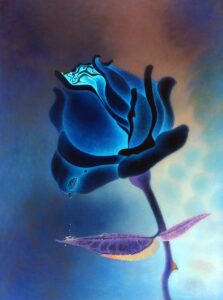
Meditations on The Virgin
Following is an ongoing series of meditations and commentaries on the spiritual meaning of “praying to the Virgin” and of “mother earth”. It is written in the form of an extended exercise, with emphasis on organic observation and thinking in the way described by Rudolf Steiner.
Originally this was meant to be a description in very simple terms of an approach to experience I have practiced for over 30 years on a daily basis, due to my professional work as a psychological astrologer. This approach has evolved over time, I have observed it, questioned it, and sharpened it considerably.
My experience is obviously limited, but I use it as a small, tiny window from which to understand through imagination, inspiration, and intuition what Rudolf Steiner sometimes says that I feel is similar –obviously in kind not in scope– to what I experience.
Nevertheless, I had never put it in writing, and first I offered only a small outline to illustrate how one could approach one aspect of the Marian cult that is directly accessible to physical observation. The challenging and disqualifying replies encouraged me to write extended comments on the nature of anthroposophy, so I started the adventure of putting into more authoritative words the result of my experience, and explain better the approach that I had outlined.
I feel the need at this point in my life to review and clarify my own concepts, and believe and hope that putting these in writing may be of help to others. It has been an adventure because I have never seen it taking shape conceptually like this, and the mental focus necessary for doing it has resulted in a spiritual awakening.
Often the language and the resulting concepts sound “so Christian” or Catholic, and this is something I contemplate myself with wonder and gratitude. To me it is like a journey where I am exploring what is inside my soul, and I have tried to use words and concepts that will be meaningful and useful to everybody.
The material is organized in the form of meditations or commentaries. The first part (Nos.1-19) is focused on “the Virgin” and on the methodology of the exercise, followed by the meditations and commentaries on “mother earth” (Nos. 20-23).
Juan Antonio Revilla
San José, Costa Rica
April 2010
1
There are today very large portions of the world’s population that seem to be able to establish a personal connection to spiritual beings, and perhaps the most extended and common example is the cult of the Virgin Mary. This has nothing to do with spiritism, clairvoyance, or traditional paths of spiritual Initiation.
Is this conscious or not? Does this “Virgin” really exist? What is the meaning of praying to or conversing with the Virgin? Is this an authentic spiritual experience or just a form of self-hypnotism?
It is very easy to judge what an experience like this might be and apply to it a pre-fabricated label and a nice little diagram that explains it all, but when we are there to observe we realize that it is not a matter of presuming to know beforehand, rather, we must let the observation grow inside of us, and wait until it begins to reveal itself as we contemplate it in mental stillness.
The contemplation of the picture we form of the experience in our minds slowly begins to pour itself in us like a state of grace where we have imaginations, inspirations, and intuitions that come from it as a gift, and our gratefulness is expressed through the clarity of the concepts that we are able to produce about it. These concepts complete the cycle of reciprocity and one “rests”, even though in many cases the concepts are only questions. When the reciprocity is fulfilled this way, the answer to the questions looses its urgency and is not important.
In other words, we “know” the experience, we have learned, we have changed because of it, even though we don’t know the answers.
Before we can say that we know an object, we must first be able to hear the thoughts of this object in us. To achieve this we must empty our soul and concentrate on the object accompanied by the intensifications of certain feelings like wonder and surrender. When we have practiced this enough, thinking about the object begins to pour in us and concepts begin to take shape through the weaving activity of our inner soul forces. This state of having thoughts and forming concepts is experienced by the soul as a blessing similar to the blessing of the green color in Nature. This is the grace and the gratitude. Without fertilization by these feelings, thinking cannot come alive in us.
The idea is to give life to our thinking by means of disciplined imagination, inspiration and intuition, liberating it from the brain. This is achieved by the cultivating and enhancing of the *right* feelings with the forces of our *I* present in thinking.
Inspiration is not something that “one thinks”, it is an arresting experience of something that comes like a breeze, something that one receives and completely fills our soul in full consciousness. It has little to do with the logic of the brain. The Arts are closer to it than mere conceptualization. Together with Imagination and Intuition as Rudolf Steiner uses the terms, they are an expression of living thinking.
Concepts are quite a different thing, they are produced by this thinking through the medium of the brain and are needed for communication, but are of secondary importance, they are derivative time-space encasements of this living thinking, and are therefore of limited or relative or of some specific value or usefulness. When the concepts are not the result of direct experience, but are borrowed from the past, other people, other times, other cultures, then the thinking becomes a force of death not of life.
What does it mean to be able to converse with the Virgin in full consciousness with an enhanced living thinking? This is the question I will try to answer little by little.
feeling cannot lead to living thinking. Only through thinking. Imbued with forces of the will. The two have an action of feeling. Feeling then is at the center of our attention during meditation.
J: I am not suggesting or implying that feeling alone leads to thinking, what I’m saying is that feeling together with thinking is necessary for the thinking to become alive and “made flesh”. The problem is when feeling interferes with the thinking, when it intrudes, and that depends on the type of feeling. But without –for example– a feeling of reverence or respect for what comes to us from observation (in this case the feelings toward the Virgin someone may have), the thinking is merely “correct”, but it doesn’t become “true”, it is not living.
What I am and will be describing is the contemplation of a feeling of faith and devotion evoked by the Virgin, by means of the mental picture that is associated with it. It is not important if the feeling is ours or of someone else. We suspend judging and concentrate on the picture, allowing our soul to be filled by the feeling that stems from it. We enhance or enrich this activity by approaching it or “enveloping it” with feelings of wonder, reverence, concordance, surrender. When we are doing all this consciously and deliberately, observing the feeling, the thinking begins to appear (it strikes us, it springs, it pours on us) in the form of imaginations, inspirations, or intuitions. This “fruition” is felt by the soul as a state of grace.
I mentioned “surrender” as an example of the enhancement or amplification or intensification of feeling, by means of which we form a relationship where we allow our soul to be filled by the object, thus establishing a real, actual reciprocity between subject and object. We “surrender” consciously, with opened eyes, observing everything but at the same time feeling it and observing ourselves doing it. Then thinking of the object begins to appear in our soul, we begin to form concepts in the form of imaginations, inspirations, and intuitions that are in themselves the object, and we fill blessed: the object has been born in us, we have been impregnated by it, and we bear fruit in the form of concepts.
For clarity, one could speak of the thinking at the start of the exercise I described, and the thinking at the end, and use concepts such as awareness of thinking, feeling and willing in oneself at the start vs knowledge of the object in terms of inspiration, imagination, intuition at the end, or thinking (of the object) without content at the start vs thinking with content at the end. But there is a concept that is probably simpler and more to the point: the thinking at the beginning is thinking about the relationship we establish with the object, the thinking at the end is the thinking of the object itself (thinking with which, by the way, we also establish a relationship)
The first (the relationship) is what some call “the method”, i.e., the way of relating to the object. When we come to understand that this method is not a prescription or a recipe but a series of principles that must be practiced creatively and differently in each case, we have the concept some have of Anthroposophia as a living being in contrast to “Spiritual Science” which is the conceptual formulation made by Rudolf Steiner 100 years ago. So when we set up to approach a specific experience or object of knowledge in an “anthroposophical way”, this living being makes itself present and sheds its light on the process, guiding the knower, giving him confidence, etc.
Whether you call Anthroposophia or Spiritual Science anthroposophically oriented, it makes no differences. To call it Spiritual Science does not scare away people.
J: The point is not how we call it, but to understand the difference. Let me try to summarize it in the following way:
There are few in the world who are interested in becoming spiritual “scientists”, yet everybody is hungry for a direct experience of the Spirit. Anthroposophia is a gift of true knowledge for everybody who has this hunger and is willing to receive it, it is not for a select group or sect who is interested in the works of Rudolf Steiner. This gift cannot be received unless it’s offered as living knowledge, and for the large majority in the world this is impossible if we don’t develop first a language that comes directly from their lives. This language we must find and develop ourselves in response to the direct experience of what these needs are in the real people we meet. If we disregard the characteristics and actual, concrete spiritual needs of the souls we would like receive this gift, and simply reproduce the conceptual language of Rudolf Steiner, then what we say is mere theory and goes only to their heads, where it becomes a sickening agent that must be rejected by the healthy forces of the soul. Presented that way it is not heard except by a few, and Anthroposophia is born dead, lost to those who need it more.
2-3
We could conceptualize the same process of thinking described before also in the following way:
We have in front of us an experience which consists in observing people talking or “praying” to the virgin, and we are not sure what to make of it, we don’t really know what is going on; but instead of stuffing the observation with our petty prejudices and speculations, or with general concepts taken from some book, we assume an attitude of respect to what we are seeing, and just keep seeing without bringing in any concepts, we keep seeing and wait with a feeling of humbleness, letting our eyes be bathed in what we are seeing (or hearing), without fear and without reacting, just observing with the eyes not focused on one particular spot of the picture but on the whole of it, and we make sure that we keep this picture in our memory so we can keep “seeing it” after we are no longer there.
At this point we have not come up with any thoughts about the experience, but this doesn’t mean that we were not thinking, only that the thinking was not intellectual or conceptual, and was focused on executing an action which consisted on not reaching any conclusions yet. The thinking was directed to the establishment of a certain type of relationship with what we were observing, and on observing ourselves doing it. Later on, when the focus is not the observation but the picture that remained in our memory, the situation doesn’t change: we allow the picture to stay focused in our field of inner vision while we continue with our daily living, doing other things. If the picture is vivid enough, or the impact of the experience on us was strong, this picture acquires a kind of life of its own inside of us, it starts working on us, pouring its virtue or power on us.
This virtue and power is the result of the moral soul forces that we brought to the experience ourselves –which act as a fertilizers or enhancers– combined with the forces that were present in the experience in the first place. Note that this won’t work when this strong impression happened in spite of us, when it was forced: we need to allow the impression to happen on us as a result of our own contemplative mood and the quiet disposition of our soul, and this requires a strong, healthy, and balanced *I*. Emotional disturbances that result from a weakened *I* blur our perception and observation capacities, and make impossible the transparency, the inner peace, the concentration, and the reverence with which we need to approach the experience. Once the necessary receptivity or gestures of the soul are present, the virtue can start to operate on us.
When the virtue and power work on us we have the imaginations, inspirations, and intuitions that are full of feeling. When the *I* is strong enough, we produce “concepts” from these through the medium of the brain by means of language, poetry, music, dancing, and the like. This is the conceptual content that has resulted from the thinking that was “inside” the experience in the first place but which nevertheless we brought to life through us in order to be able to express it. This content however is not a finished product yet, further thinking is needed until a point is reached where the thinking feels complete. When this point is reached, the concept has become flesh and begins to “die”.
This description differs from the previous one in that the feeling of faith and devotion is not the direct focus, not consciously at least, as it was in the previous one. It turned out this way because when writing it I was thinking more on the original question, which was “if all this stuff is real or merely a form of self-hypnosis.”
So instead of giving a conceptual answer, I change my attitude and position myself in such a way that the experience itself provides an answer in terms of imagination, inspiration, and intuition.
My own answer to the orignal questions was “could be, but in many some cases it is real devotion and faith”, changing the focus directly to this feeling. What would change in the description would be that instead of referring to “the experience or observation” one would be saying directly “the feeling of faith and devotion”, which is what I would be seeing. The image in memory that eventually “pours” its virtue on us would be more directly a specific feeling.
One can speak of this kind of description as an example of an exercise in living in such a way that we begin to liberate thinking from the lunar forces of the brain, making it more solar, a method developed by Goethe which is within the reach of everyone. Its aim is not to make of us spiritual researchers, but to make our thinking “more true”, more organic, more related to life, more etheric or “Christic”.
4
Once the necessary receptivity or gestures of the soul are present, the virtue can start to operate on us.This may not become conscious until 2 or 3 days later, and the experience itself that originated the picture may have lasted a few seconds only: the important thing is that it impressed us strongly enough, and we approached it with the necessary respect and humble silence, letting it work on us.
The reason for this shift is the time our etheric body needs (or may need) to process the experience (of the astral body) and convert it into concrete imaginations, inspirations and intuitions. Some people need more time, others can process it right away without the intervention of this extension in memory, in which case the direct experience is no longer of the senses only, but an authentic spiritual perception. The more we practice this “delayed thinking”, the less time our etheric body will need to chew or grind the experience. When the concrete thought appears, it has become part of our organism, it is part of our blood and our breath, and we have been changed by it, we have become it –partially at least.
Sometimes this processing does not occur properly, it remains partial and incomplete. This happens when the forces of the *I* are weak, so the person cannot find the right way of relating with what comes from the experience or from the memory image associated with it. In these cases the concept never acquires a concrete form and remains alien, confusing, or without life, cold and abstract, hardened and dogmatic, it is “not true”. It can also become pathological, the person can become paranoid, defensive, delirious, and the thoughts that begin to appear or “pour” are torturing, sadistic, absurd, or just plain mad: the *I* is so weak that it is lost. These distortions are a form of “bleeding” and show that enough attention was not paid to the necessary gestures of the soul or feelings that should be present as a starting point.
Please keep in mind that I am not talking of “occult development” directly, but of the meaning of “living thinking” in everyday life as I understand it. Imagination, inspiration, and intuition are alive and organic, they appear in many different forms and variations, in many gradations, and their content is individualized and impossible to predict in advance. They are the way in which spiritual beings manifest themselves as thoughts in our soul, but these thoughts are not “just me”, they contain their object and this object belongs to the world. They are a spiritual experience “made flesh” in the real world of everyday experience, they insert or add themselves to the experience we obtain from our physical senses without us having to interrupt our normal consciousness: the two types of consciousness remain together and appear simultaneously. They don’t follow the rules of logic, the rules of the brain, and in simple rational terms become paradoxes or riddles…
Like the riddle of this relationship that some are able to establish with the Virgin.
5
If one observes a specific instances of this relationship but remains indifferent to the feeling that is its fuel in very large portions of the population of Mexico, Central, and South America, we are probably approaching it with a certain passivity, with our intellectual minds only. It is difficult to observe this relationship without noticing the strong presence of a feeling of surrender, humbleness, devotion, and faith that is driving the soul at the time of praying or talking to the Virgin in a shrine. This feeling is very personal, very immediate, and very abundant, and it induces in the person living it a state that one can characterize as “full of grace”, one can sense a beauty radiating from their heads.
A passive observation without the awareness of this feeling atmosphere that characterizes it doesn’t feel real, it is not eloquent enough to leave a strong impression on our soul and bear fruits upon its contemplation. The indifference to the feeling must not be confused with the observation of the feeling. When our astral sensibility tunes itself to that feeling, we vibrate like the wind playing the strings of a harp, opening ourselves to it, which enables us to see it with our soul rather than just our intellect. If we don’t let this “wind” impress our soul, there would be no real feeling to contemplate.
This last image of “the wind” that plays “the strings of my heart” corresponds to the level of inspiration in the astral body and is subjective, but I think it illustrates the need for the original observation to be not a routine intellectual exercise but a state of attention that requires a strong “presence of mind”, an intensified state of consciousness that demands the forces (thinking-feeling-willing) of my awakened *I*. At first we don’t know what it is, but we pay attention and wonder, treating the situation with respect, acknowledging “Life” that has brought us to it and is trying to talk to us through it.
What we can learn from this experience may have nothing to do with the Virgin as a spiritual being, but we can learn what is essential of the experience itself, i.e., of a person talking to the Virgin… or it may happen that we get inside of us the image of a spiritual being that covers the person as if if with a dark blue mantle (imagination in the etheric), looking down and pouring itself on the person in complete surrender and compassion (inspiration in the astral), or we can look at its eyes and witness how it looks at us and talks directly to our *I* (Intuition), and we can hardly stand on our feet.
This knowledge is not “exact”, it is not being translated into spiritual scientific terms, but it is “true”: we touched the object with our soul, we embraced it, for a time we were the object (surrender), and the experience was so powerful that putting it in conceptual terms may feel out of place and unnecessary, we know that what is demanded from us by the Spirit is to pay tribute to it, to honor it, and we are expected to do this through our actions in the world rather than our thinking. In Steiner’s words paraphrasing the prologue of John’s Gospel: “it is full of consecration and of truth”.
6
With this I don’t mean to describe any actual supersensible experiences, but to illustrate the possibility of having one simultaneously with what we are perceiving through the senses. The point is not how to attain supersensible perception, but how we can relate to experience or perception in a way that the knowledge we obtain from it is “true” or “living”. When the relationship we establish with experience is the “right” one, we prepare our soul to receive the gift of imagination, inspiration, and intuition (in many variations and gradations), i.e., of relating to things in a way that is not merely rational or dependent on what can be perceive by the senses.
Imagination, inspiration, and intuition do not constitute knowledge by themselves. They may talk to us and we may not listen, or we may get it all wrong and go mad, etc. We must apply the forces of our *I* expressed in thinking, feeling, and action from the very moment of observation, all through the contemplation and the final processing in the form of concepts. We are not worried about developing our ability for supersensible experience, but about making our experience strong and healthy and our knowledge “true” and alive. This in turn enhances the imaginations, inspirations, and intuitions as well as well as the activity or movements of the *I* through thinking, feelings, and action.
The importance –from my standpoint– of this approach to knowledge suggested by Rudolf Steiner is that it is accessible to everyone, and not just to those who are committed to become spiritual researches like him. Everybody needs a direct experience of the Spirit, but only a small number want to become “spiritual scientists” or are interested in the conceptualized teachings of Spiritual Science. Nothing supersensible or necessarily spiritual is present at first when we simply delay judgement and wait until the facts themselves or direct experience “fill in the blanks”, but as with Goethe, the mastering of this approach leads us towards Life, towards living thinking, instead of a lifeless and deadening conceptualization.
What is living thinking?
Before looking for an abstract definition, please consider first the following description by Rudolf Steiner:
“Let us suppose that a man who has developed this feeling, this attitude of surrender, in a rather high degree, looks out over the fresh bright green of a meadow. At first sight he cannot distinguish the colours of any individual plants; the whole presents a general appearance of fresh green. Such a man, if he has really brought the attitude of surrender to a high degree of development, will perforce feel within him at the sight of the meadow an inner sense of balance; he cannot help being moved to feel this mood of balance – a balance that is not dead but quick with life, we might compare it to a gentle and even flow of water. He cannot help but conjure up this picture before his soul. And it is the same with every taste, every smell and every sense-perception; they inevitably call up in his soul a feeling of inner movement and activity. There is no colour and no tone that does not speak to him; everything says something, and says it in such a way that he feels bound to give answer with inner movement and activity – not with judgment or opinion but with movement, active, living movement.
“When our etheric body grows together with the objects of the world, then we have the impression that we cannot let these objects remain as they are in our ideas and in our conceptions and thoughts. They change for us as soon as we come into relation with them. Suppose a man who has already experienced the mood of surrender in his soul is looking at a green leaf, full of sap. He turns the eye of his soul upon the object before him, and at once he finds he cannot leave it as it is, this juicy green leaf; the moment he beholds it he feels that it grows out beyond itself, he feels how it has in it the possibility to become something quite different… The green leaf stimulates him to feel within him something of a budding and sprouting life. Thus he grows together – quite literally – with the green leaf, feeling in himself, too, a budding and a sprouting of life. But now suppose he is looking at the dry and withered bark of a tree. If he is to grow together with that he cannot do otherwise than be overcome with a feeling of death. In the withered bark he sees – not more, but less than is there in reality. If anyone looks at the bark from the point of view of external appearance alone he can admire it, it can give him pleasure, in any case he does not see in the dead bark something that shrivels him, piercing him, as it were, in the soul and filling it with thoughts of death.” (ref.GA.134-2)
Now for a more conceptual explanation:
Cosmic thinking is a never ending impersonal motion of creation and destruction, of utterances of higher spiritual hierarchies that never stop changing or metamorphosing, always moving and never reaching a point of rest. We contemplate it or hear how it comes and goes like a river without end or beginning and without time, like eternity.
Living thinking is this cosmic movement incarnated in our reality, a bridge between the Spirit and human experience in the consciousness soul; it is how man’s Spirit knows the world, not through concepts or rationalization but through a dialectical movement between the *I* and the world more akin to music or to a song, like a dialog of reciprocity.
Anthroposophia is an expression of this living thinking, of the cosmic thinking of the higher hierarchies filtered through our human experience of the world. But there is something else: it appears to us differentiated, incorporated into and organized body of knowledge, encased in concepts and a personal style that are expressions of Rudolf Steiner’s personality and the spirit of the times in which he lived.
Furthermore, this particular conceptualization is usually printed in stone and the conceptualized encasement becomes doctrine and is no longer living, it is only repetition or association of concepts that were not born out of the souls of the real people to whom they are being communicated, as they originally were when they were created. Anthroposophia taken this way is devoid of spirit.
7
The essential thing about Anthroposophia, what makes it a living being and stand apart from other spiritual movements, is not the what but the how. If it were the what –the conceptual/intellectual content– it wouldn’t matter who brought this content out, it could have been a medium, your next-door neighbor through automatic writing, or a robot coming from outer space appearing in your backyard, or the devil himself: the spiritual virtue is not in the concept but in its shape, its conformation, and in how we relate to it. This is evident in all Steiner lectures and writings; all the power of his will manifest in his thinking is directed toward the proper way in which we arrive at concepts. If we don’t pay attention to this way in which it came to be formed, the concept is born dead. Anthroposophia is not the concept, but the life that animates this concept. The Michael impulse resides totally in how we relate to knowledge of the spiritual worlds, not in the accumulated information and gossiping that we repeat in our heads, it is this “how” what makes it alive, it is in the gesture where the real thinking is.
The point in the example of seeing someone from e.g. Mexico praying to the Virgin is how we arrive at concepts or ideas about it, how we can position ourselves in such a way that we can let the experience express itself, how can we hear it in such a way that the contents of our thinking comes from it and not from us, and the starting point of this positioning is to delay our judgement, to let it form itself organically in us over time. We have to “interiorize” the object, we have to be able to touch the object with our soul –or let the object touch our soul–, and allow this “touch” do the working in us in a delayed way. How long is this delay depends on how much training we have in this; eventually the imagination, inspiration, or intuition will come to us immediately, simultaneous with our sense perception, constituting a true spiritual or supersensible experience. But even in this case, although the thinking is present there fully in our enhanced state of mental alertness, we should not precipitate opinions about it: this would kill the life of the object in us and bring sickness to our soul.
If we want to know something deeply, we must take it in our soul first with a feeling of humbleness, respect and veneration, of wonder, with a mental silence. Then the object will act on us, pouring its virtue. This attitude or gesture of the soul requires the full presence of the *I*, it requires that we are able to “touch” the object and that we let it “touch” us. This “touch” is what produces the imaginations, inspirations, and intuitions through which the object reveals itself to us as a gift. This is impossible if we are not “transparent”, if we do it with desire, with lust for knowledge, if we don’t vibrate with the object, if we don’t empty ourselves first. Then, having emptied ourselves and surrendered, everything becomes liquid, we can “touch it” and see it in the eyes, we can hear it, we “know it” through our thinking and our feelings, we know it through the movements of our *I* that flows through it, penetrating it likes waves of continuous, everlasting music resonating inside and outside us both. Then standing up we both say “Now what?” and we respond: “Nothing”.
If someone says to me now: “This is only lofty, pretty words, it is not knowledge”, or comes with the prejudiced-filled idea of labelling it “mysticisms” and “feelings only” or “subjective”, I respond: this is Life and it is knowledge, the most alive and concrete knowledge possible. It is also “living thinking”. It is not by any means “scientific” but it is true and beyond subjectivity and objectivity because it is both. It becomes possible only if we let “the other”, the object or “things” grow in us, and only if we apply to it the concentrated power of thinking as the observing and inquiring movement of the *I* aided by the concentrated power of feeling. It is a state that may last a fraction of a second, it may come to us only as reflection by means of imaginations, inspirations, and intuitions, it may be as if our head has grown so big that it can no longer remain in our bodies and we expand with our etheric body, yet we are in full control of our sense perceptions and physical body, we are incredibly alert but we have the power of the Sun in us manifesting itself as the action of liquid drops of gold all around us, and we feel that we are pouring ourselves on the object, filling it and loving it as the object fills us and we feel loved in return, while at the same we remain “detached” from all of if, observing and wondering, without questions and without looking for answers.
Every phenomenon of the world, every object of observation, draws a picture of itself in the etheric stream of time. This picture is impossible to observe with the physical senses, which can give us only a fragment of it; to observe it directly we must remove our consciousness from the brain and enter in the stream of our etheric body. Then we realize that the picture never acquires a definitive shape, it is always in metamorphosis from one state into the next, always moving, gesturing, always becoming, revealing itself to us through this movement and gesturing in the current of time, until it eventually dies away or becomes something else. To “know” the object our thinking must follow it and change shape together with the object, assuming the many forms in which the being exists in the world. I we are unable to do this with our thinking, the object disappears to our consciousness.
When we limit or reduce our thinking to concepts, then we are not thinking any more, we are not creating. Thinking is the etheric stream of consciousness that gives birth to concepts, while concepts can be considered as “thoughts” (I think Scaligero would call them “thought thought” –pensamiento pensado, dead or dying thinking). A concept has a definitive shape established by its relationship to other concepts and by the rules of logic, and its content is the result of time/space determinants such as language, culture, personality, “the spirit of the times”, etc. Concepts are necessary and play an important role in the world and specially in communication. The problem of Anthroposophy is not working with concepts, the problem is when the association by means of memory and the repetition of concepts produced by Rudolf Steiner substitutes thinking, or pretends to pass as if it were thinking. Then Anthroposophy is no longer a living spiritual being, but a sect of followers that depend on Steiner.
8
There are many thoughts that can be derived right away simply by observing with attention and methodically, but we usually don’t do that and instead accommodate the object of observation very conveniently into our established conceptual universe. However, in this case, we want to observe with attention and learn from it, as if the experience were really new and important to us. The difference with ordinary thinking in this case is that we are not interested in registering the observation as a sum of physical parts or details but as as a whole, we want to know its meaning, its place in the universe, we want it to reveal itself to us, to reach its soul and read it like an open book, breaking the lock that the order of nature placed in front of us, like God telling us: “it is not for you to know what is going on in the object’s soul, you can know it only indirectly, but you shall never have access to the actual experience of the other soul, you are condemned or locked inside yourself, this knowledge is forbidden for you!”.
But then we remember that Rudolf Steiner said (ga 136-5):“by means of a special enhancement of the experiences which we have in ordinary life in the feelings of sympathy and love, by raising these feelings to the occult path, we may succeed in pouring forth our own being, coming out of ourselves, as it were, and plunging into the being we wish to observe.”
Let’s go back to the original example of observing someone praying to the Virgin. We are using our eyes but are not looking for anything physical, so instead of fixing our line of sight on one specific point, we look at the object as a whole, as if it were a landscape where everything is distant, or we were looking at the starry sky, looking at everything from the corner of our eye. The focus of the observation now is the atmosphere that surrounds the object, the movement or gesture, which in this case is a feeling that for us constitutes a riddle. We observe faith, devotion, a state of grace, an inner beauty and humility that shines from the head and induces to look down, to close the eyes, or to cry, we feel humility, etc.; but instead of looking coldly with our intellect, we come alive and open our souls to it, letting all those feelings touch us with enough strength to leave a lasting impression in us. We don’t let our intellect corrupt the experience, we surrender to the feeling while we quietly and silently observe ourselves feeling it. We allow this feeling to work on us freely while we observe, wondering and in a state of profound respect for the integrity and value of what we are observing, feeling its riddle and silencing any desire to obtain answers: we only open ourselves and feel grateful for what we are receiving.
It may happen that the object doesn’t have so much intensity for us. This means that the observation must be “enhanced” in different ways. One way is by concentrating on feelings, as I have been describing, or we could also carry on a systematic series of similar observations over time, multiplying them so that the effect left on our soul is reinforced, and we could expand the observations by experimenting with different objects and carry on comparisons of our response so that eventually we can identify what feelings are associated with what objects and we become very sharp doing this. This way are the things themselves, the objects (in this case the feelings of faith and devotion observed), that begin to talk or be audible to us, telling us about themselves. I begin to know them, I become familiar with those feelings, even though I have not come up with any concept or have constructed any theory about them.
Up to this point there is nothing supersensible and there is no theory or concepts about the object, but there is real knowledge. However, if we have reached this point we observe one thing: the feeling that was the object of observation is no longer attached to the physical act of observation, it is no longer attached to any individual person in an act of praying to the virgin: we have come to the point where to perceive or experience the feeling we don’t have to go look for it in a Church or some other place, but it seems to live in us and have a life of its own. It is not a matter of remembering because it is no longer attached to a specific person or event, a specific time and space, yet we are able to “see it” when we focus our attention or our thinking on it. When we focus our thinking this way, we no longer are using our physical organs and have begun to “see” by means of imaginations, inspirations, and intuitions. Then the thoughts about the object begin to appear, they fall upon us like a gentle rainfall that we know is a gift of gratitude and love that comes from the object itself.
9
The feelings observed: faith, devotion, sorrow, etc. are “the object” of observation and conform a whole, a presence, a landscape or an atmosphere of colours. Observing is never passive, it requires a strong focus of attention that is deliberate, we must know how to observe and do it with discipline, we want to position ourselves correctly with respect to the object, to establish the right relationship to it, which must be characterized by our feelings of wonder, reverence, etc. without which the experience does not bear fruit in the form of thinking that is alive or true knowledge. When Steiner describes this he uses (ga 134-1) the word “feelings” (wonder, surrender), but I think a more accurate term is “gestures of the soul”. In this case the gestures are the object of observation and even though one characterizes them by means of different words (faith, sorrow, etc.) they form one single whole, they are part of the same landscape.
These gestures –because of their kind– leave in us an impression similar to something that has surrendered, or more accurately, of a filled cup that has just passed its point where it has started to overflow. The feeling-gestures contain a movement, like a sort of dance, even though the external physical circumstances may appear static: the person may be completely immobile, yet the gesture contained in the act of praying that we perceive is a movement. This movement is like a river that flows between we as observer and the gesture of the soul that is being observed, and this movement produces in us a feeling-response which is another gesture, a movement that has sprung in our soul. When this movement-response has appeared in us, when we observe it happening, it means that we are already touching the object’s soul, and our response-gesture is the knowledge that we obtain from it, a real, concrete, satisfying knowledge which –however– is not exact and has nothing to do with concepts or theories, or with science.
NOTE: I’m not saying that there is no place for science here, or that this type of science is not needed. I’m saying: this is a type of knowledge which is not exact but is true. We can make it more exact (assuming that it is within our possibilities), but for this a sharpening and intensification of our thinking is needed. This sharpening of thinking –in differing degrees depending on each individual case– is required when we want to *inform* of this knowledge, when we want to communicate it and make it meaningful to an audience. The sharpening may also be called forth by the object itself, the cycle of reciprocity may not be complete until we inquire more into the object’s soul, so the thinking becomes more “exact” naturally– but even then it would not be “scientific”. I personally cannot see the necessity of being “scientific” about this type of soul-knowledge)
Later on we are able to identify this landscape of soul-gestures under different circumstances, we recognize it independent of the original person who appeared to us “enveloped” in it. For example: one can see sometimes the same attitude or gesture enveloping a young mother who surrenders to the little child in her arms. The action or movement however is here inverse: in the first instance (praying or talking to the virgin) one can feel the colored (very bluish) atmosphere “pulling” the person towards it, the strength resides in the atmosphere. In the second instance (the mother looking down to her child in arms), one can perceive the strength pouring down on the mother and covering her. These two different events or observations, in turn, make me realize that the observations I considered before I brought this example up, of a watery life-giving light in the earth’s atmosphere(*), is a different phenomenon, the gestures are very different. This light is golden and solar, with a redeeming, liberating quality, it is more open; the other is bluish and its gesturing is more “enclosing”. One is more social and proactive, the other more intimate and silent.
(*) NOTE: We can see today a kind of etheric light in the earth’s atmosphere that is life-giving and freedom-giving, joyous and fresh like spiritualized water and light that flows and pours itself on everything living. It is almost physical thanks to a collective heightened consciousness, a certain level of consciousness reached by humanity today that is related or akin to a love of the earth, the protection of animals, ecology, human rights, etc. It has a lot to do with pre-Christian earth religions and shamanism, except that these appear now full of the Christ spirit. This light comes directly from overwhelming pain of the earth or the world, however it is not the pain but its transmutation, and it pours into people’s souls in the form of love and strength to act beyond all concepts and beliefs. Our perception of this etheric life-giving light-water, the gift of bathing in it, is a result of working-out the raw experience of life and the pain of the world with the awakened powers of the *I* expressed in acts of love. It has absolutely nothing to do directly with doctrines or teachings of any kind.
10
When we dream something, we are closer to the truth or to spiritual reality than when we think about it with our intellect by means of the rules of logic. Logic cannot takes us to the Spirit, rather, it is when we are able to break its rules, to crack them with the power of true thinking, that the door opens. In dreams, the Spirit talks to us in pictures, not through the pictorial content itself but through its movement, its rythm, its music or structure. The spiritual virtue is not in the content of the pictures, but in the forces that gave birth to it, and in the relationship or interaction of these forces.
With Anthroposophy is the same: the spiritual impulse or truth is not in the conceptual content, but in the forces that brought about this content, in how it was formed. We have to be able to “see” this formation, to picture it, otherwise the content is born dead in our minds. This is why Steiner always said: “we have to grasp this in the right way, and before we can think of it properly, we must develop the right feelings for it”. These feelings are our response to the spiritual force, and they are created in our soul by means of the internal life or movement of pictures, by means of a pictorial, imaginative language.
When we form these pictures in our imagination, we are experiencing the spiritual forces that create them, but the picture itself is of secondary and relative importance only. Spiritual knowledge doesn’t lie in the picture or in the conceptual content that comes with it, but in the force thanks to which both were formed. The pictorial or conceptual content, by itself, without these forces, is dead thinking, and can be repeated or disseminated by anyone, spreading its death everywhere.
The spiritual virtue or power of pictures is in their inner movement, in the gesture they produce in our soul when we contemplate them, in our feeling response to them. When this response is unconscious, we are like sleepwalkers, mediums, or visionaries. When we make this feeling response conscious, observing quietly how it appears in our soul, grasping the process with our *I* the forces that are creating this feeling, holding the formation of the feeling in our intensified thinking, the medianic response is transformed into imagination, inspiration, and intuition.
Imaginations, inspirations, and intuitions, have their own independent life inside of us. When they are developed and cultivated in the right way, with the focused thinking activity of our *I*, they become direct spiritual experiences that appear in the unending flow of our consciousness, they become the content of living and true thinking, even though this living thinking is not necessarily (or not yet) exact or scientific. However, they push the awakened forces of the *I* to make the thinking that lives in them “concrete” in the world by means of language, music, painting, dance… or through “the art of living”.
Living thinking is not the thoughts but the virtue in them. Its proof does not lie in its exactness or its being scientific, it lies in its fruits.
11
It is intriguing the fact that a mother with her little child in arms has similar qualities or “colors” than a person praying to the Virgin. We know nothing yet about what this “Virgin” is, but we already know that it represents “the common denominator” of these two unrelated events: praying to the Virgin has qualities similar to those of motherhood, and motherhood has qualities similar to those of praying to the Virgin; the difference being that these qualities appear to be working in opposite directions in each case. We were able to know this because we concentrated our attention on what seemed to be the essential aspect of the two events: the feelings, and this was possible because we enhanced our observation by means of our feeling response to it.
Now I would like to find more events like these that share the same or very similar qualities, and learn more from the comparison. Since we are talking of feelings, it is very easy to find many other events with the same colors or when the same type of feelings are present, but if we limit ourselves to this we would always be returning in circles to the nature of humans, and we would be tempted to conclude that the Virgin is a human creation — this is in fact is what is ordinarily done. So instead of looking for these events in the human world, we will try to look for them in the natural world, and compare them.
In the animal world it is easy to find striking examples of motherhood, but the question arises: do animals pray? when can it be considered that an animal is praying? Is the mantis (the insect) praying? Or (categorically) animals never pray?… And when we look at the plant world, it is easy to discover imaginatively how some flowers –for their shape and colors– can be compared to the human act of praying, but where do we find “motherhood” in the plant world? And what about the mineral world, is there praying and motherhood in a mountain or a stream, or in rocks?
These questions may sound absurd, but if instead of concentrating on the pictorial content of what comes through our eyes we concentrate on the quality of the movement that is inherent in these pictures, if we can connect to the inner life and movement of its colors, concentrate on the gesture or attitude that this movement suggests to us through feeling, if we concentrate on the dance that they are dancing, if we concentrate on the movements of our soul in response to the breeze that comes from these pictures when we are in a state of humble and respectful observation, we then would start to be “in sympathy” with the formative forces themselves, and they would start working on us in the full light of our consciousness.
Do we really know all that? It sounds like a pseudo intellectual theory, not an observation based on empathy.
J: The observation is not “based on empathy”, empathy is part of what we have to observe. It’s not theory but a simple observation. If it “sounds like a pseudo intellectual theory” to you it is because you did not follow my explanation or because you are not seeing the same thing, but how would you know if you were not there? You are missing the point which is to illustrate an organic method of thinking applied to a common experience (in this case “the Virgin”). That you agree or disagree with what I personally see is irrelevant. What is relevant is the procedure that is being followed.
How can we be sure that our feeling observation are true?
J: That depends on what you mean by “feeling observation”. Feelings are neither true nor false. Without an observer, there is no object and no knowledge, so we must pay attention to the relationship between the object and the observer, and for this we observe the object as well as ourselves. If we cannot recognize or observe any feeling-gesture or soul-gesture in the object, it means that we are doing it wrongly and we have to enhance or enrich the observation by cultivating the right kind of attitude in us, which includes approaching the object with wonder, reverence, empathy, surrender, etc., and enhancing our powers of attention and concentration; then the object starts to become more eloquent and we can look deeper into it. Once we are able to see those feelings in the object, we must observe the way in which they “hit us”, how they affect us, what feeling response they provoke. This feeling response in us comes in the form of pictures or movements, as when we try to draw the music with our hands, or it can be an arresting feeling (inspiration), or a desire to do something specific (pictures). When this happens and we are observing it consciously, instead if being carried away by the feeling we can transform with our thinking this movement or gesture that the object is producing in us into knowledge of the object and of ourselves.
You should try to start from the heavenly Virgin instead of starting from the mudball of Earth.
J: We should start from what we all see and experience, and drop prejudices and abstractions like “heavenly” vs “mudball Earth” to the trash can. Your prejudices against the mediation of feeling in the thinking process make you react to what I say before understanding it, and the result is that you criticize what in essence is identical to what Steiner repeats over and over in his lectures.
The sharpening of our thinking forces is necessary and present at every step in the form of observation and self-knowledge, from beginning to end, and is greatly amplified and unrelenting later when dealing with the imaginations, inspirations, and intuitions, but instead of seeing this, the tendency so far has been to react with strong prejudice against the role played by feelings in the process, distorting everything I’m saying.
In Cleargreen pages there at least used to be a photo of a praying prairie dog, they do it in groups for half an hour in the morning and again in the evening. They pray to the sun. The researcher says he does not want to anthropomorphize, but that he certainly thinks it looks like praying, they hold paws together, that’s all. And turn toward the sun. And sit quietly.
J: So the “praying” analogy comes (presumably according to this) from holding paws together, looking at the object, and sitting quietly while looking at it.
Note that the mantis religiosa does just that, but nobody thinks it is praying. The same can be said of most predators in front of their prey: they sit quietly in front of it, looking at it… the position of the hands may be deceptive.
Maybe what the prairie dogs do can be considered close to “praying”, but the explanation why we think that way that you mention here is missing the essential element: the feelings. It is these feelings what makes us associate the behavior with “praying”.
In other words, the act of praying is not in the picture itself but in the feelings contained in the gesture represented in the picture, and even though we do not “see” a feeling like a physical object, all of us actually can or could “see it” present in the picture that comes to our eyes. The reason why we can “see” a feeling is because this feeling is evoking a response in our soul, we react to it with our own feelings, and it is this reaction what allows us to say: “here is a feeling that has such and such characteristics”. This does not appear to our eyes in the object, it appears inside of us, but we know that it comes from the object, that we are in some way looking inside the object.
I’m using the word “feeling” here in the same way Steiner does, but have suggested that a better word would be “soul gesture”: a feeling response is a gesture of the soul that is always contained in the object’s “countenance”. Every phenomenon in this world, every object of observation, every event of our lives, presents to us a face that expresses its mood, emotion, or character, and most of us ordinarily can recognize and see this character or mood even though it is not a physical object.
What we think we see in the countenance of a disease, an accident, or an act of praying, is a result of the feeling-response it evokes in us, and very often we can get a false impression, we “missjudge”. What I’m describing is how we can discipline our observation in such a way that the thoughts we develop about an object or phenomenon can be more truthful, less prone to error and closer to the reality of the object. This is done by following Steiner’s explanations of Goethe’s “organic” way of thinking and the role of feelings, dreams, and imaginative language in spiritual cognition.
As a result of this method the truth of the object appears to us in the form of “meaning”: to “clearsee” the object is to grasp its meaning. This meaning appears as an explosion of light in our thinking, as an intuition. But we do not keep the intuition to ourselves, this intuition is pushing to become concrete in the world, to become flesh, and this is done through the creative forces of our thinking. For some, depending on each observer’s or thinker’s temperament, this concretion may come in the form of words, for others in the form of painting or of music, or sculpture: they all are a human language through which the spiritual becomes concrete or uttered in the world.
“It is not possible to operate directly on feeling, nor it is wise along the discipline, to appeal to feeling, outside of its immediate resonating for the contents of meditation and before having distinguished from it feeling and willing. (Scaligero, Yoga Meditation Magic, 97, 1971)
J: I have been talking, in my description, of 3 type of feelings: we start from those that appear in the object, e.g., the object of observation is a feeling. But we cannot “see” feelings directly with our physical senses, so before there is something to observe we must bring this feeling of the object into our consciousness, and for this we concentrate on the gesture, the movement, the life and direction of colors in the object. Then we begin to interiorize this, to intensify it by means of a second type of feelings that Scaligero (apparently) is calling here “immediate resonating for the contents of meditation”.
We observe or contemplate this resonating, which appears in different forms and degrees of imagination, inspiration, or intuition; it can have the form of a feeling or the form of an impulse to do something translated into a picture. I have not paid attention before to the difference between feeling and willing in the resonating response, but have considered it a form of feeling, noting that “gesturing” is a better word. I mentioned in a recent post that it can appear in different forms to our contemplating or observing: a picture, a feeling, an impulse or desire to do something specific, to make a gesture. Instead of being carried away or controlled by our resonating response, we (the *I*) take this content and transform it –through our thinking– into concrete or “true” knowledge about the object. This knowledge “pushes” to become concrete by means of language, but the language is conceptual only sometimes, in many other cases it is musical, or other forms of art.
The important thing at this point –I would say– is not to distinguish between feeling and willing but between what –in our soul– comes from us and what comes from the object. This can only be achieved through self-knowledge and self-observation. The organic method I’m describing minimizes or removes the interference or noise produced by what comes from us, from our ego. A special kind of transparency and soul disposition is therefore required, and this is achieved by cultivating during the whole process the kind of feelings or soul-gestures that Steiner describes (wonder, reverence, tuning, surrender…). Here, apparently, Steiner differs from Scaligero.
12
Let’s imagine that we have become acquainted ourselves with the object, we have established a relationship with it, we developed ears to listen –in a limited way– what it wants to say through imagination, inspiration, and intuition, but this “bluish being” in itself is just a phenomenon.
The analogy of the starry sky is useful: we may become acquainted with all the stars by name, we can recognize the constellations, we can get so familiar with them that we know where they are even without looking, only from the corner of the eye; we can learn to recognize their colors and their changes in position and brilliance through the seasons, compare them with others and form impressions in our soul that can become imaginations and inspirations.
We know “some things” or characteristics and describe them in a more or less careful or scientific way. But even though what we describe is beyond what is perceivable by the senses, the real being is still locked for us, it remains outside our reach.
Most of the descriptions given by materialistic clairvoyants are of this type, and sometimes they are full of phenomenological details. But instead of looking at these details we must focus our attention on the formative forces that are acting on the object and bring about these details.
The supersensible phenomena observed by ordinary clairvoyance is like a dress or a mask, a veil; it is like perceiving someone’s aura and not being able to see or know the real person behind it, we don’t know how this person is relating to himself or herself and to the emotions and thoughts that result in the appearance of the aura.
But we have been given the gift of listening to what its soul says, to see it doing, becoming, transforming, pouring itself on us and on the world, i.e. we have entered its aura, we are relating to it, we are holding hands knowing and loving each other, we are “in communion”.
This communion is the point of blossoming, where as human beings we have reached our peak, and our soul rests. But the peace and consummation that comes from this communion doesn’t mean the end of learning or of thinking, we have barely scratched the surface only.
This is the point where the personal soul-search ends (in Christo morimur), where the *I* surrenders, and true spiritual knowledge(*), the world-spirit, begins (per Spiritum Sanctum reviviscimus). Between them is the movement of the eternal spirit expressing itself through the unstoppable current of living thinking in our consciousness.
(*) “… thinking is empowered to become an experience whose body, in a certain measure, is thought, and which takes up into itself as soul the Spirit of the world.”(Rudolf Steiner, ‘The Story of My Life’, 1928, 265)
I tried to describe this from my personal standpoint in the next meditation in the following way: “The ego strives to fathom the experience with the expanse of its own limitations, but it knows it can’t so it enters in communion with this higher being, surrendering to it completely, and this being then bridges the ego to the eternal Spirit, to the *I* or Spirit Self. What emerges from this process is living thinking, that solves the separation between the object observed and the observer and allows the object to listen to itself in our thinking.
13
When we see a spiritual being from the perspective of an observer, it becomes “a presence”, it makes itself present or appears under certain conditions or situations that are of the same quality as this being. When we become conscious of this presence it means that the being and our soul are “touching” each other, vibrating at the same level; our consciousness has reached out to the level of the being, and therefore we talk of a “visitation”, as something to which we relate person-to-person in equal terms. This being is never passive, and it reveals its nature to us by the way it touches us. Its nature is that of a force with direction, it always has “intention”.
When its presence remains unknown to us then the being is the experience itself: not the particular situation or circumstances, but our direct experience of them. In other words the “stuff” of which the experience is made is what the being is, the being and the experience are one and the same. Conscious observation introduces our *I* in the equation through the free movement of our thinking, and this changes the meaning of the experience by shifting the focus to the new relationship we establish with it. This modelling of the *I* into the experience, is a point of freedom that we call “the relationship”.
This relationship is a higher spiritual being that bridges the separation between the observer and the experience being observed, or between our “ego” who is having the experience and our *I* who is observing it. The ego strives to fathom the experience with the expanse of its own limitations, but it knows it can’t so it enters in communion with this higher being, surrendering to it completely, and this being then bridges the ego to the eternal Spirit, to the *I* or Spirit Self. What emerges from this process is living thinking, that solves the separation between the object observed and the observer and allows the object to listen to itself in our thinking.
Without intense and authentic feelings towards the object of wonder an respect, of humility and gratitude, of surrendering, the ego hardens and gets lost in its own fabric of abstractions, argumentations, and intellectual constructions and concepts that are the result of brain activity. Living thinking cracks through this activity of the brain and flows like an unstoppable river into the etheric stream of Life, creating and destroying concepts, always transforming and surpassing itself, always becoming and unconditional, uncompromising, never fragmented, dying and living and living and dying, always surrendering and obedient.
For thinking to come alive it has to become free from its own content, it has to become a spiritual creative force. This is achieved through quiet and silent but unrelenting observation of its own activity, of its movement during the process of cognition. But this process is not an abstraction, it is the concrete experience of knowing, of apprehending the world through knowledge, the movement between the object and the observation of the object before our thinking acquires its content. When thinking consists of concepts and abstractions and argumentations it is trapped by its own dead or dying (and deadening) results.
The process of cognition I have been describing is one in which the forces of thinking are allowed to move organically, directing them in a different way, effectively breaking the habit of building concepts and abstraction and calling them “knowledge”. This is done by a special discipline and intensification of feelings, which allows to liberate the spiritual formative forces of thinking by focusing our attention on our feeling response to these forces, and guiding this feeling in such a way that knowledge comes directly from the spiritual forces in the object, without the mediation of concepts and abstractions that cripple the soul giving it a false sense of security.
14
Developing in ourselves the right feeling-attitude towards the object of observation, it becomes possible –through the re-education and discipline of feeling and thinking that has been described– to hear, to touch, to visualize, to know the feelings, the inner movements of the object’s soul. This knowledge is direct and concrete, it is like a river that one sees coming and going from the object to us and from us to the object, like we relate unselfishly to a friend.
When we use this approach to seeing someone praying to the virgin, and later attempt to describe the experience, one realizes that it can described from different points of view. We have so far only characterized the atmosphere or colors of the experience as a whole, the feelings that permeate it, the presence, perceived as a certain type of movement, gestures, and feelings. I have characterized this filling presence or color atmosphere as a combination of faith and devotion, surrender, humbleness, a state of grace, a feeling of beauty that radiates from the head of the person praying, a sensation of purity intermingled with sorrow, and –I add now as an important component– a feeling of rest. All these appear as presence that permeates everything, leaving in us the impression of a full cup that has started to overflow.
If instead of the presence or atmosphere we focus our attention on the person, we realize that all these feelings are more accurately described as “feeling-states” or states of being; all together they constitute the act being executed. We begin to see the feeling of “rest” that permeates the atmosphere more clearly as a conscious act where intellectual thinking has stopped and thinking appears surrendering and dimming, we see the person offering herself or himself, “dying” as it were. So despite the physical stillness of the act, the offering or rest is perceived as a movement of the person surrounded by the feeling atmosphere or presence, that seems to embrace everything with a deep blue mantle that produces sensations of pink and lighter yellowish tonalities on the skirts.
Throughout this we watch the weaving motion of our thinking, making connections not by means of concepts or “conclusions” –those would kill everything– but by means of pictures in our imagination. This pictorial movement of thinking has a life of its own and is two-dimensional, it doesn’t “go through”. The power of this pictorial thinking is concentrated on our attention, on our eyes: it seems to have no limits or no ending, it comes and goes threading things together. It moves with our *I* (or our eyes or field of vision) and is subject to our will, but it is not fueled by desire or possessiveness of any kind, we watch it and let it flow naturally as if guided by an invisible hand. It never stalls or dies, when we are ready the pictures begin to shift focus and transform themselves.
When we have a clear enough imaginative picture or feeling of the object, we can compare it with other similar objects. For example, we can contemplate the differences between praying to the Virgin, praying to God, and praying to a Crucifix. We can look not for “formal similarities” as in the above example, but for similarities of content, i.e., experiences with similar colors and feeling-atmosphere that would otherwise appear as unrelated. This way we discover that a mother reclining her head in sorrow toward her child in arms, or a person overtaken by compassion for a helpless animal suffering in the street, have an almost identical presence or “enclosing” bluish atmosphere as when we observed a person praying to the Virgin, the difference being not in the mood but in the direction of the movement in each of the three cases.
For example, I mentioned the difference that can be observed in the movement during the act of praying, where the strength seems to be concentrated on the presence that is pulling the person to it, “holding” the person, while in the case of the mother one sees the presence pouring itself on the mother, as if filling her with strength. In the case of the helpless animal on the street one can observe a bending motion in the person similar to that of the mother, even though the person remains physically stiff or unmoved; one also sees something similar, but with the colors reversed, in the feelings of the animal, and the same presence is perceived as in the first two examples. As we begin to shift our focus to the world around us, pictures and sensations, sounds and smells appear in our consciousness, and even though their colors and moods may be very different, their morphology is the same (or viceversa) and we recognize them as the same presence, the same being.
For example: the phenomenon of a gentle rain on an open field has the joyful mood of a new beginning, and is directly opposite to the enclosing mood of the act of praying. But when we look deeper following the path of “morphological observation” we can see how they are related to the same living spiritual being that is present in them.
15
The phenomenon of rainfall can be used to understand better “what is going on” in the act of praying to the Virgin. In rainfall, or more accurately in the observation of a field covered by rainfall, the same moods can be found as in the act of praying, as well as the same movements or morphology. Everything that we see contained or enclosed in praying (as well as in human and animal motherhood) inside human consciousness is present in rainfall but transformed into an experience of Nature that is wide open.
Sometimes rainfall is also enclosing and prayer-like: think for example on the darkness or heaviness of the sky, the excess humidity and cold, the looking for cover and warmth, the bluish moodiness of the atmosphere, and above all, the feeling of resignation. This feeling of resignation is another essential aspect of the experience of praying, it is the point where sorrow is becoming purity and beauty, as when we get all wet by the falling rain and our clothes tend to become transparent, leaving us “naked”.
The gentle rain on an open field lead us back to an aspect of the act of praying to the Virgin that we had not considered yet, without which it is not possible to understand the phenomenon that people in Mexico and Central America call “the virgin”. This is a phenomenon that may be difficult to understand to those not familiar to the experience of rainfall in tropical countries: the smell of wet soil (tierra mojada), the mixture of warm sunshine and water in the atmosphere, the hot humid breeze full of natural smells, the dryness and thirst of the soil and the plants waiting in lethargy for the water that will come hopefully from heaven.
… all this points to the fact that the prayer of the human soul who has come consciously to surrender to “the Virgin” can be –and frequently is– met by an answer from Her. The feeling of grace and beauty comes from the Virgin, it is her gift or blessing, like gentle water falling from the sky. This gentle rain (in our country we call it “garúa”) is more traditionally called “dew” (rocío). I remember when I was a child and this gentle rain was falling (garuando), we were told “the Virgin is taking a shower”.
When the Virgin answers the mood changes profoundly, a transformation happens in the soul: this is the beatitude. The deep bluish is changed by silver inside and becomes sky-blue (color celeste) and light-yellow, with tinges of pink. This may sound like pretty words only, but when we look at the rain outside (with reversed colors) in these tropical regions, the answer from heaven is literally the difference between hunger and poverty and feeling blessed by Life, because without rain the crops will not grow. For them , the Virgin is the rain, and it pours her blessing on their souls with as much abundance as on the land.
16
In many cases nothing or very little of the feelings I’m describing is actually present, so one keeps observing until there is nothing more to observe, and starts looking somewhere else or waits for some other time when the necessary conditions are met. The important thing is that once these feelings have been internalized or embraced by our soul, our contemplation or focus on them reaches a point when they begin to have a life of their own inside of us, independent of our sense perceptions. This independent life is in the form of a picture or recollection which may or may not correspond to one specific sense experience, it may be synthesis of many of them.
The more similar conscious experiences we have accumulated in our life, the more we personally resonate to these feelings ourselves, the more clear and fruitful the picture will become as it transforms itself, speaking to us through imagination, inspiration, and intuition. This super-sensible picture (or series or pictures) works like a synthetic recollection of something we have seen, of one or of many experiences we actually had, and we keep returning to it in order to “remember” more of it each time. The more we quitely and patiently contemplate or meditate on it, the more unrelenting and sharp our thinking forces become, in complete independence from the external world.
The image of rain and the experiences associated with it provide the opportunity to work our way backwards to the feelings associated with praying to the Virgin by means of recollections that are completely independent from religious imagery: we don’t have to know anything previously about the Virgin in order to find our way to it, all that is needed is the ability to observe in a disciplined, special way our own accumulated experience, or the experience of others. If we don’t have those experiences or recollections in us, we must look for specific instances where those feelings are abundant, and open our soul to them in the special way that has been described.
Eventually the presence that we are calling “the Virgin” becomes more and more familiar, more concrete, and we develop the ability to perceive it directly or immediately with our hands and arms, we can feel it and touch it in our immediate experience when the necessary conditions are met. We find that there are some spots, as well as some definite moments, where this presence is strong. We can observe –as if from the corner of our eye– its formation by spiritual forces in those specific moments or spots, and the better developed our hands and arms organs are, the better we can identify those moments or spots as well as its colors, gestures, and shape.
17
When one contemplates these pictures imaginatively, one can see the silver-white inside that has become sky-blue and light-yellow outside; the tinges of pink mentioned is the love or affection contained in the response of the person that feels blessed and loved by the Virgin. In rainfall the sky is obscured and one can observe imaginatively these colors reversed: white-silver inside the line where the rain hits the plant or the ground, and a wide band of pink on top of the plants with a border of radiating yellow, incarnating the response of the soil that feels blessed by the rain. (NOTE: these colors is only the result of my own imagination at the time of writing when I saw these pictures and focused on “thinking in colors”. I could not proclaim them as scientific or objective facts.)
The image of rainfall allows us to understand the reality of the Virgin outside and beyond particular beliefs and religions, and see it as a truly universal human experience. Rain is a blessing for the peasant who depends on the land to survive, and the land responds to this blessing by fructifying, by opening up to the future. For the modern urbanite rain is practically the opposite: it leaves us wet and helpless (“humiliated”), making us seek refuge and confinement. This is a long way from the confining of the act of praying or the experience of the sorrowful mother from which we started our journey, but morphologically they are still the same: the only difference is that one is the existential rain inside the human soul, the other is a phenomenon of Nature.
The intimate meaning that rainfall has for the peasant in the tropics dramatizes the aspect of praying to the Virgin that we had not considered at the start: the fact that the Virgin responds to the prayer, she listens to us filling us with her grace, traditionally characterized as a gentle rain or “rocío”. And we reciprocate with our intense selfless affection and loyalty. This is a key without which understanding the phenomenon is impossible. The believer is loyal with the purest form of affection and devotion, loving the virgin and feeling loved in return. This is perceived –for example– as one approaches the Basilica: the devotion people feel for her can be felt everywhere, there is no confinement, the original dark-blue of sorrow and resignation is gone and all is sky-blue and light yellow, with the scent of beauty and the tenderness of flowers.
The feelings of helplessness, of sorrow and poverty, feeling neglected and abandoned, lead the person to praying and surrender that appears in the soul as an impulse of the will, an act or action, a positioning. This attracts this being with its enclosing blue mantle and the compassionate gesture. This normally remains unconscious, but in the act of praying it is often made conscious. Then sometimes there is a moment that is timeless, silent, and thoughtless, completely pure and incorruptible, where the encounter with this being is experienced by the soul: they touch, and the soul’s response to it is the change of colors and feeling loved or blessed. What falls or pours on us like rainfall, and our feeling response to it, are simultaneous, they are not separate, and the virgin is both.
Fresh, flowing, clean water, and rainfall are the garments of this being in the world of Nature: she is the goddess of the bountiful earth, the promise of the fruits, the warmth and humidity of the earth’s bosom that guarantee fertility and the continuation of life. In Man and the animals this exists internally as embryonic formations and the experience of motherhood, but the spiritual forces that are behind them are internalized by the *I* and transformed into soul-states and spiritual processes that normally happen in complete separation from the world of Nature. In countries that are very poor, however, where the majority of the population depends on the soil and the seasons, the two remain together. For them the “supernatural” in the figure of the Virgin is as immediate and palpable as the relationship they have with Nature.
Are these mythical characters or goddesses the same being as Mary, the mother of Jesus in the Gospel of Luke?
J: Before I can provide an intellectual answer to this, I would like to consider briefly the visions associated with the apparitions and revelations, which I have not considered before.
The individuals who usually have these revelations or visions have not, as a rule, developed their intellectual faculties, their clairvoyance is instinctive or atavistic. They are being hit or invaded by an elemental force that appears to them as a person, but the appearance of this person –or what the person says to be– is not what makes it “true”; what makes the vision true in the eyes of the witness is the force itself which is immediately recognized as familiar by the astral and etheric bodies without the intervention of the intellect or of consciousness.
The question of the identity of this person is an intellectual one, and I think is the wrong way to approach the problem. The vision assumes a very specific appearance and language taken from the witness astral and etheric *unused* forces, and partakes of the astral and etheric forces of the place, so we may think of it as syncretic, but in my opinion its immediate appearance or spoken words are not important from the spiritual point of view. The important thing to understand is not the content of the vision but the force itself, how this force interacts with us.
Now I can answer your question. I need to look at it in the following way: Is this elemental force the same as that of the ancient goddesses and myths? — Yes in the visions, not in my descriptions. Is this force Mary the mother of Jesus? — Not at first in the visions, although with time it develops or can develop into her; in my descriptions the answer is “Yes, I think it is”. Why in both cases? The answer or clue is how we relate to the experience, what role or position our *I* or consciousness and our freedom is playing in the experience.
18
When I think on the Marian apparitions, the image of a seed that has just started to sprout appears, and this image is followed by that of the full-blown plant that has become a focus of the Marian cult: a church has been built on the place to serve the countless visitors or pilgrims that come by the thousands or millions. The church rises like a plant and contains in its architectural forms, in a concentrated way, the mystery and the faith surrounding the Virgin. Each specific place has its own characteristics or particular atmosphere, but what I think is common to all of them is that it feels like a place of flowers, a place of offerings, a meeting place between the earthy and the heavenly, a place where individual differences have vanished and some collective power is present, but this collective power or mystery has bloomed.
(NOTE: it is interesting to observe, while writing about this now and on previous posts, how I can feel the scent of flowers, and how this scent wants me to write in a certain way. There is a movement of love similar to being kissed above the forehead, or blessed, and the flower is this kiss when it is consciously experienced).
The phenomenon has to be seen from these two opposing but complementary points in time that illuminate each other, and the shrine or place itself is a vortex where the elemental formative forces coming from “mother earth” or from “María la lluvia” that gave birth to the apparition in the first place, are continously springing forth. These forces are collective in nature, “chtonic” or telluric, and are being met by what comes from the spiritual world thanks to the fervor of the million who come to the place. The meeting place is the flower or blue rose in people’s hearts: this experience consecrates the place. In the time-vortex of the Marian shrine Marfa la Lluvia (Mary the Rain) Mother of Life and Mary the Mother of Jesus meet, becoming one another and carrying us in their arms.
The historical moment of the apparition itself is a watershed of elemental energy personified that strikes the astral and etheric bodies of one “chosen” person with a young or underdeveloped mind. It commands obedience and sacrifice for the sake of the collectivity, and it seems to feed from the unused or unconscious astral and etheric forces of the person having the vision, who can be perceived from outside as “not healthy”. There is something dark and chtonic, something that feels “luciferic” and steps upon individual freedom, something that –though religious– doesn’t feel spiritual. But when one looks from the side of the full-blown shrine, it becomes clear that the seed sprouted from this big personal sacrifice.
The lack of freedom in the Marian apparitions is shown in the fact that the shrine is tied to a specific place, it is “telluric”, which shows also its collective nature: it is “of the earth”, tied to the earth’s elemental formative forces. Nevertheless, when we look at the phenomenon organically, it is not difficult to realize that it is fulfilling a specific function, a specific need of the times, so it is not only a phenomenon of space but also a phenomenon of time. Its meaning is the phenomenon itself when we see it from the other side of time and we observe how the “Virgin force” pours itself in the hearts of men who come to meet her in the collectively augmented earth-power of the shrine. Through the Virgin the human soul enacts her humbleness during the act of praying and receives the gift of love, the rose, from the spiritual world.
19
I want to present here an abstract, a conceptual sketch or summary, of what we have found so far:
- – the Virgin cannot be approached or understood through abstractions.
- – she gives us spiritual nourishment and cultivates our soul.
- – this nourishment is made of the memories of our spiritual life before birth.
- – we receive this nourishment from her continuously, every day of our lives.
- – this nurturing is found by different means in different cultures.
- – praying to the virgin is a state of being, an act of surrender that may come about unconsciously.
- – this act contains in itself the answer from her, her blessing.
- – the Virgin’s blessing is the fruition of all life, of the earth and of the sky, and the fruits of the spirit.
- – without her all life is barren.
- – she is a mother and everything living is her children.
- – she dissolves all separations and sorrows.
- – true spiritual knowledge can only come alive through her, it is she who brings it to life.
NOTE: These meditations continue with “Meditations on Mother Earth”.