by Juan Antonio Revilla
San José, Costa Rica
last edited May 29, 2026
I.
There is great confusion among astrologers about how to calculate the Black Moon, identified with the position of the lunar apogee. I will deal here with the astronomical definitions and categorizations, without delving into the astrological meaning.
Astronomically, there are 3 types and 7 variants of “lunar apogee”: the types are “osculating”, “mean”, and “natural”. From the “osculating geocentric apogee” (1) are derived the “osculating topocentric apogee” (2), the “osculating topocentric perigee” (3), and the “osculating topocentric empty focus of the lunar orbit” (4). To these are added the so-called “interpolated” apogees, which Riyal calls “natural apogee” (5) and “natural perigee” (6). The “Mean” apogee (7) by definition excludes short-period fluctuations and therefore has no variants (see explanation further below).
II. The Mean Apogee
The “Mean Apogee” corresponds to the apogee or perigee of the reference lunar orbit used by astronomers to construct lunar ephemerides. It moves very regularly in a perfectly circular orbit with a radius of 405,863 Km around the Earth/Moon barycenter, i.e., its positions are not geocentric, but the difference between its barycentric and geocentric position is never more than 0,40′.
Despite what one may think in theory, though, the barycenter does not really have any effect in the calculation of the lunar apogee. Astronomically, the concept of “mean apogee” (or of mean elements in general) excludes by definition any differences between geocentric and barycentric. These differences represent short-period fluctuations that have been already averaged-out in the “mean position”. In other words, when talking about mean orbital elements and positions, the geocenter and the barycenter coincide, there is no difference between them. Therefore, there is no “barycentric” *mean* apogee. For this same reason, there really is no topocentric *mean* apogee, since the difference between geocentric and topocentric is a short-term fluctuation and is excluded in the definition of “mean”, it has already been averaged out. Of course one can always calculate barycentric and topocentric equivalents of a “mean” position, but they have no astronomical meaning.
Therefore, when using the MEAN apogee or perigee, the geocenter, barycenter, and topocenter all coincide, there is only one, not 3 positions. Likewise, the MEAN empty focus and the MEAN apogee will always be aligned, i.e., their longitude will always be the same. This sounds a little odd, but this is what the *mean* lunar elements represent: an average devoid of any real-world short-term fluctuations.
In the case of the “true” or osculating lunar apogee (see below), one must keep in mind that it is usually calculated from the *geocentric* position and velocity vectors of the Moon, therefore there is no barycentric equivalent. The periodic fluctuations between barycentric and geocentric positions do not have any effect on it, because the barycenter is never part of the equation when it is calculated. In other words: there is no “barycentric” true apogee or empty focus. The osculating apogee is already geocentric from the start, and it always coincides with the position of the empty focus of the lunar orbit.
NOTE: I have to thank Alois Treindl for helping me see these points clearly after a discussion last February in the Riyal_Compute forum. After the discussion Alois added a clarifying note to the Swiss Ephemeris documentation and I added a corresponding explanation in this compilation (see below).
Seen geocentrically, the line of the apsides (i.e., from perigee to apogee across the orbit) is identical to the position of the “empty” or 2nd focus, sometimes called “kenofocus”. This empty focus is an essential aspect of the Black Moon symbolism, and is the basis of the ideas and metaphors I developed in my Black Moon essay at my site.
The circular, extremely regular motion of the fictitious mean lunar apogee / Black Moon belongs to the world of solar symbolism. Such type of motion is alien to the lunar world and to the symbolism of the Black Moon. Although I respect the experience of astrologers who don’t question the validity of this mathematical point, my mind, accustomed to find the astronomical symbolism reflected in the astrological symbolism, finds it impossible to identify this point with the “dark” world of lunar symbolism represented by the Black Moon.
III. Topocentric Positions
One of the many proofs that astrology does not deal with what really happens in the sky, besides the fact that the mean lunar apogee is completely fictitious and its motion has little to do with the real changes in the lunar orbit and in lunar motion, is to realize that the apparent topocentric position of the Moon (relative to the observer), which can differ by more than 1 degree from its geocentric position, is almost never used by astrologers, that almost invariably use the Moon’s geocentric position.
The difference between the geocentric positions of the lunar apogee and the lunar empty or 2nd orbital focus reaches 6.4 degrees every 27 days; however, when we compute their topocentric positions, this difference (a result of “parallax”) reaches a maximum of 7.9 degrees every 6 months. It gives rise to 3 topocentric variants of the Mean Black Moon, which can be labelled as:
the topocentric equivalent of the geocentric position of the Mean Lunar Apogee
the topocentric equivalent of the geocentric position of the Mean Lunar Perigee
the topocentric equivalent of the geocentric position of the 2nd or empty focus of the mean lunar orbit
Topocentric positions are normally not used in Astrology, but the large difference of up to 7.9 degrees between the geocentric and the topocentric empty focus of the lunar orbit shows that of all points in an astrological chart, this is the one closest to the Earth, much closer than the Moon, giving a more personal perspective of basic or primitive lunar symbolism than anything else in a chart. The unicorn and Priapus-like or –as Axel Harvey calls it– Charybdis-like symbolism of this point is enormous. Recapitulating:
1-) the ordinary, traditional “Mean Black Moon” or mean lunar apogee is not geocentric but barycentric. It orbits the Earth/Moon barycenter, located in a straight line between the centers of the Earth and of the Moon about 1350 Km inside the Earth’s crust (both the Earth and the Moon orbit this point once every 27 days).
2-) the Mean Apogee is a fictitious point that is used only as reference, it does not represent the true orbit of the Moon at a given point in time. Its orbit is a perfect circle with a radius of 405,863 Km, and its motion is almost completely linear or – symbolically– “solar”.
3-) if instead of the apogee we think of the mean empty (or second) focus of the lunar orbit, which is closer to the basic “Black Moon” symbolism, its barycentric position is the same as that of the mean apogee, but the radius of its orbit is 42,230 Km.
4-) the apogee is measured from the vernal equinox (0 Aries) along the lunar orbit and not the ecliptic, so it has a latitude that is a function of its distance from the node and can reach more than +- 5 degrees. This latitude produces an oscillation of +- 0,06′ in the ecliptical longitude of the apogee.
5-) the transformation from barycentric to geocentric is never made in astrological practice. It results in an oscillation of +- 0,40′ when the Black Moon is defined as the apogee, and of +- 6.4 degrees when it is defined as the empty focus of the orbit. In other words, the geocentric position of the apogee can differ by more than 6 degrees from the geocentric position of the empty focus of the orbit. They are the same only in the barycentric reference frame, not in the geocentric.
6-) if we are interested in the observer or topocentric –not the geocentric– point of view, then the difference between the barycentric and the topocentric positions will periodically reach as much as 7.9 degrees.
7-) the distinction between the barycentric and the geocentric position applies also to the mean lunar node. The transformation from barycentric to geocentric produces an oscillation of +- 0,44′ in the position of the node, although this distinction, like in the case of the apogee, is never made.
😎 when calculated geocentrically instead of barycentrically, the mean perigee and mean apogee will no longer be 180 degrees from each other. They will be different also from the topocentric point of view.
9-) the 3 frames of reference: barycentric, geocentric, and topocentric plus the 2 points of the axis (apogee and perigee, ascending and descending node) produce the following variations of the lunar apogee and node:
– ordinary mean apogee/perigee (barycentric)
– geocentric mean apogee (+- 0,40′)
– geocentric mean perigee (+- 0,40′)
– geocentric mean empty focus (+- 6.4 degrees)
– topocentric mean apogee (+-0,40′)
– topocentric mean perigee (+- 0,40′)
– topocentric mean empty focus (+- 7.9 degrees)
– ordinary mean ascending node (barycentric)
– geocentric mean ascending node (+-0,44′)
– geocentric mean descending node (+-0,44)
– topocentric mean ascending node (+-0,44′)
– topocentric mean descending node (+-0,44)
We have then no less than 7 variations of the *mean* Black Moon only, and 5 variations of the mean node. Their values will all be slightly different.
Besides the comments of Alois Treindl in his source code for “Placalc” in the mid or late 80’s, which he later reiterated in the Swiss Ephemeris, I have never seen anyone else making a distinction between the barycentric and the geocentric position of the mean lunar apogee (this distinction does not exist in the case of the true apogee, which is already geocentric). Since I am not familiar with the French “Lune Noire” literature, I don’t know if that distinction is made in Europe.
Alois Treindl’s commentary inspired me to investigate further the matter of “mean apogee positions”. Unfortunately, he never went on to offer the calculations in his software (barycentric to geocentric and then geocentric to topocentric positions of the lunar node and apogee), so I have nothing against which to check Riyal’s accuracy. The Swiss Ephemeris assumes the mean node and apogee as geocentric and then tranforms them to topocentric; the topocentric positions of the true or osculating node, apogee, perigee, and second focus –which do not need to be transformed from barycentric to geocentric– agree with Riyal’s.
NOTE: In early February 2005, I personally asked Alois Treindl why the distinction between the geocentric and the barycentric apogee, though mentioned in the Swiss Ephemeris documentation, is never made in the Swiss Ephemeris program itself. We had an exchange of emails on this subject in the “Riyal_compute” forum, the result of which was an important clarification. Alois wrote:
“The whole concept of a mean orbits precludes consideration of such short term (monthly) fluctuations. In the temporal average, the EMB [Earth/Moon Barycenter] coincides with the geocenter… It is probably pointless to compute topocentric positions of mean points – a contradiction in itself. Don’t do it, or don’t expect meaningful results from it.”
He subsequently added the following note in the Swiss Ephemeris documentation:
[added by Alois 7-feb-2005, arising out of a discussion with Juan Revilla] The concept of ‘mean lunar orbit’ means that short term. e.g. monthly, fluctuations must not be taken into account. In the temporal average, the EMB coincides with the geocenter. Therefore, when mean elements are computed, it is correct only to consider the geocenter, not the Earth-Moon Barycenter. In addition, computing topocentric positions of mean elements is also meaningless and should not be done.”
As a result of this clarification, the conversion from barycentric to geocentric –and from geocentric to topocentric– mean lunar node and apogee was immediatly removed from Riyal. The “true” or osculating apogee is not affected by any of this.
IV. The “Corrected” Apogee
The erroneous “corrected” apogee used in Europe is based on a regular sinusoidal correction of 12.x degrees (the amplitude varies among different authors) applied to the mean apogee. This came as a result of efforts to find the “true” position when the astronomical theory necessary to calculate this “true” position had not been developed. The ability to calculate it was there, but the method of calculation, based on the position and velocity vectors of the Moon (the method used in Riyal), was not readily accessible to astrologers.
This situation changed only after the publication of “Lunar Tables and Programs” in 1991, authored by Jean Chapront and Michelle Chapront-Touzé, astronomers at the Bureau des Longitudes and developers of the most modern and accurate lunar theory to this date, called “ELP-2000” (Riyal uses a truncated long-term version of it called “ELP2000-85”, published by the same authors in 1988. I had been following the development of this theory since the authors’ first publications in the early 1970’s until its final working version introduced world-wide in 1984.

The tables of the trigonometric expansion of the mean lunar apogee to produce an accurate approximation of the true or osculating apogee, published in the above-mentioned book in 1991 and based on ELP2000-85, made evident that the “12.x” degree correction used by some astrologers until then (promoted by reputable thinkers such as Jean Carteret), was wrong from every point: one, because the real maximum difference between the true and the mean apogee was not 12-13 degrees but 30, two, because the “main solar perturbation term” (period=31.8 days) on which this correction was based was not “12.x” degrees but 15.4 degrees, and three, because the so called “correction” used by astrologers, and for which tables had been published, etc., was being applied in the opposite direction.
These facts were not known even to astronomers in general before the 1991 book by the Chapronts. The “ignorance” here was for practical and historical reasons: the true or osculating lunar orbit was a factor that had not been a part of present-day lunar theory since it began to be developed in the late 1800’s. Lunar theory was (and is to this date) based on a reference or idealized ellipse that establishes the so-called “Delaunay arguments” from which to build the trigonometric expansion of the 3 lunar coordinates: longitude, latitude, and distance. In this process, the mean reference perigee/apogee is used to form the arguments of the trigonometric terms, but the true instantaneous position of the apogee is never needed.
It may come as a surprise that an accurate theory of the true or osculating lunar apogee did not come until 1991. This may give an idea of the complexity of the Moon’s motion and orbit in space, and the enormous difficulties that theoreticians of celestial mechanics had to face to develop a suitable theory for it. So it is no wonder that astrologers — or even astronomers– had an erroneous understanding of the real instantaneous motion and gravitational perturbations of the lunar apogee/perigee. There were theoretical developments and approximations, but nobody had tried the real numerical solution until the Chapronts published their results.
Nevertheless it is very common for astrologers to ignore or misunderstand the astronomical facts, and to this date there are still people working with this erroneous “corrected” apogee or Black Moon. The 12/13- degree gap that opens and closes periodically between the corrected (called “true” by its users adding to the confusion) and the mean position is even given special significance by some astrologers… interesting concept this gap… but based on something that is mathematically and astronomically erroneous or non-existent. Astrology has many examples of this: the Uranian planets, the Dark Moon, and in my opinion, the mean lunar apogee (more on this later).
There is an informative and detailed mathematical analysis by Cees J.A. Jansen of the tables published by Duval-Font in France of the positions of the corrected “vrai” Lilith here:
www.ceesjansen.nl/wp-content/uploads/2021/07/Apogeum-and-corrected-Black-Moon.pdf
He provides an empirical formula that reproduces the Duval-Font-Bode positions wih a max. error of 2 arcminutes. These positions are just a refinement of the phony 12.3 degrees sinusoid explained above. As Jansen comments, these “vrai” or “corrected” positions have little nothing to do with the lunar apogee. He also comments that the authors of the tables refuse to explain how they perform their calculation.
One wonders, with so many options available (we still have to see the variants of the true or osculating apogee), if the Black Moon has meaning at all. Astrology is full of cases like this (e.g., house division, asteroids…). There is no easy answer. However, I think this question disappears when astrologers realize that Astrology is what astrologers do: work with more or less fancy and abstract mathematical points in the imagination. Astrology has very little or nothing to do with our relationship with “the sky out there” or with “the cosmos”. If you realize this then the efficacy of imaginary points comes to light under a different perspective, one which has to do with cognitive patterns and structures in the human brain and not with astronomical events. It becomes a matter of individual idiosyncrasy the tools you choose to work with, and there is no fear or prejudice against tools that have no solid astronomical basis. Some people simply do not need that basis… however, I do, and I think that this basis is important in order to keep Astrology (or astrologers’ minds) disciplined and “down to earth”, i.e., to keep Astrology healthy.
V. The “True” or Osculating Apogee
Unlike the mean apogee where topocentric positions do not make much sense astronomically (and therefore, there is really never any difference between the mean empty focus and the mean apogee), the osculating or “true” apogee, by definition, represents the actual, real-world fluctuations of the lunar orbit (not of the lunar position!!), so calculating its topocentric equivalents makes sense astronomically.
The osculating orbit is a mathematical/geometrical structure modelled by means of the physical forces, often called “n- body perturbations”, giving shape to the body’s trajectory at one instant of time. This geometrical structure (the keplerian ellipse) constantly changes as time passes and the trajectory is modified due to the change in position of the object and the perturbing forces acting on it, mainly the Earth and Sun in the case of the Moon. At the times when the Sun pulls stronger, this structure or trajectory modifies its shape, i.e. the excentricity of the ellipse changes, and this is reflected in periodic oscillations in the position of both the osculating apogee and of the Moon itself. The main oscillation created by this action of the Sun is called “evection”.
The word “osculating” is explained at the end of a long compilation of posts that you will find in my site discussing the astronomical definition of the Black Moon or lunar apogee. This is the relevant part (written in June 2000):
If you look in a Latin dictionary, you find: “OSCULATIO” = kiss, the action of kissing. “OSCULOR, OSCULATUM SUM”: to kiss, to caress, to pet. The word is also in the Webster’s: “osculant” = united by certain common characteristic. “oscular” = pertaining to an osculum, pertaining to the mouth or kissing. “osculate” = 1- to kiss; 2- to come into close contact or union; 3- (geometry, of a curve) to touch another curve or another part of the same curve so as to have the same tangent and curvature at the point of contact; 4- to bring into close contact or union; 5 – to touch another curve or another part of the same curve in osculation; 6- (archaic) to kiss. “osculating plane” = the plane containing the circle of curvature of a point on a given curve. “osculation” = 1- the act ok kissing; 2- a kiss; 3- close contact; 4- (geometry) the contact between two osculating curves or the like. Osculum” = a small mouthlike aperture as of a sponge. The “moment of osculation” is only a brief moment: the next instant the “point of osculation” will have shifted in space…
That is, the osculating orbit of an object –and in particular the orbit of the Moon– is changing all the time due to the attraction of many or of several perturbing gravitational forces, so the moment of osculation is only an instant, it represents an “instantaneous orbit” that momentarily “kisses” the real orbit and then diverges as the Moon changes its position. It is like opening a momentary window to observe the orbit at that instant, knowing that it will change its appearance as soon as we close the window again, or like taking a picture that “freezes” the instantaneous reality of the orbit.</p
The important thing is that the osculating orbit IS NOT the idealized or “real” path that the Moon describes in space through time, it is a very different concept, defined by the word “instantaneous”. Some people prefer to think arbitrarily that an osculating orbit –a perfectly defined keplerian ellipse– does not correspond to “reality”, forgetting that the osculating ellipse is an accurate representation of an object’s trajectory in space at a given moment. The Keplerian ellipse, i.e., the osculating orbit, describes the motion of the object at that instant of time.
This is exactly what we do in Astrology when we make a chart: we “freeze” artificially the movement of the celestial sphere and work only with that instantaneous picture. The osculating lunar orbit is a perfect instantaneous ellipse, a mathematical construct like everything else in Astrology, whereas the “real orbit” is the path the Moon draws or describes around the Earth over time in the “real world”, which deviates as much as 7% from a perfect mathematical ellipse, so the “real” orbit through time and the osculating or instantaneous orbit are different concepts. We can think of the osculating orbit as a ghost image that the Moon carries with it all the time. This ghost image represents a sort of ideal, an “ideal future” when the Moon is (or will be) at apogee, but it keeps changing or evolving as the Moon travels through space.
We can also think of the perigee, the north and south nodes, and the empty second focus of the orbit in the same way: they all represent idealized focal points or “directions” that are a result of the “psychic projections” of the Moon, they are “Moon ghosts” or ghost structures that the Moon always carries with it, that are part of the “lunar structure” of every individual. The Moon represents the present moment, the nodes, apsides, and empty focus represent the past and “look forward” psychic projections that give shape and structure to the lunar dynamics of a person’s life. They are like the rooms, passages and corridors of a house (the different parts of the orbit) that become projections of the person who inhabits it (the Moon).
The words used (“instantaneous” and “osculating”) make it obvious that it is not the motion of the orbit (e.g. the apsides) that an osculating orbit is pretending to represent, but the so-called “starting conditions”, a window or a snapshot in time consisting of a conic section that represents the trajectory of a celestial object at that moment. These words also imply that the real motion of a celestial object is made of an unending series of these “snapshots”, each one slighly different from the other.
It is sometimes argued that an osculating orbit is the result of a simplistic or inadequate or insufficient mathematical/physical model, but we must not forget that from the osculating orbital elements an accurate or “actual” real-world planetary or lunar position and velocity vector is obtained that incorporates the full n-body calculation of all the pertubing forces acting on the motion of the Moon or any planet or satelite at a given instant of time. This is why osculating orbits are used by astronomers almost universally to model orbital motion.
Some people feel that an osculating orbit is too artificial or unreal, and call the use of the osculating lunar apogee or Black Moon “nonsense”, “close to nonsense”, “makes no sense at all”, etc. The main reasons usually given for this –besides the ones already mentioned– are 1-) the large difference (reaching up to 30 degrees) between the mean and osculating value of the lunar apogee, 2-) the fact that this osculating value “can travel to places where the Moon will never go” (see how amazingly significant this is in psychological and psychic terms!), and 3-) its erratic changes of direction and velocity, which for some it means it cannot be really called “a motion” at all.
But I have always insisted that it is precisely all that what makes the symbolism of the osculating apogee / Black Moon so powerful. It doesn’t matter at all that its motion is erratic: it doesn’t have to move like a planet because it is not a planet!… this brings it symbolically closer to all the neglected psychical projections of the Moon, both positively and negatively. The osculating Black Moon, representing the constantly changing shape of the lunar orbit from moment to moment is a very good fit to the organic, instinctual nature of Black Moon symbolism.
NOTE: I discuss this symbolism here
The changes in the shape of the lunar orbit reflected by the True Black Moon, precisely because they are swifter and more pronounced or irregular, resemble a living organism more than anything in Astrology!
Because there is discussion and controversy about using osculating elements, like the osculating Black Moon, I would like to summarize the points made above in the following way:
1- the formulation to calculate the osculating position is not “2-body only” but the full “n-body” model, inasmuch as the actual position and velocity vectors of the Moon or the planet are used. These “instantaneous” vectors incorporate all the perturbing forces acting on the object.
2- when the calculation of osculating orbital elements is done analytically by means of trigonometric expansions, the terms and coefficients of the trigometric series are modelled so that they incorporate all the perturbing forces acting on the object, the expansions are not “2-body”.
3- the osculating orbit is a mathematical-geometrical construct, but so is almost everyting in an astrological chart, from houses to 30-degree signs and the use of longitudes instead of real planetary positions. A simple astrological transit is purely a mathematical construct.
4- the osculating orbit is not meant to represent the Moon’s orbital path over time, these are very different concepts. The words “instantaneous” and “osculating” show that what is being modelled is the so-called “starting conditions”, a window or snapshot in time consisting of a conic section that freezes the trajectory of a celestial object.
5- osculating orbital elements have physical-astronomical meaning and are universally used by astronomers to model the orbits of celestial objects.
6- like the osculating elements, an astrological chart, frozen in time, is a representation of “instantaneous” positions. From this perspective, the natural apogee (see below), based on positions in the past and the future, makes little sense.
VI. Numeric Data
The mean longitude of the lunar perigee (apogee +- 180) is a quantity needed for the calculation of the Moon’s mean anomaly, which forms the basis of the 4 so-called “Delaunay arguments”, from which all the numeric deviations from a perfect circular lunar motion down to the actual accurate “osculating” lunar position are calculated for any instant of time.
This calculation approach is the result of the historical development of “analytical” lunar theory since the times of Isaac Newton. The celestial longitude of the Moon was required for the calculation of geographical longitude at sea, in the abscense of accurate clocks, and there was a frantic race to develop ever more accurate ways of calculating the lunar position. The most accurate and latest lunar “theory of motion” before the ELP2000 theory developed by the Chapronts in the 1970’s and 80’s (see below) was the “Hill-Brown” theory, developed in the last quarter of the 19th Century. Brown’s “Tables of the Moon” published around 1909 were the basis of the official top astronomical authority, “The American Ephemeris and Nautical Almanac”, up until the 1983 edition.
This calculation approach does not require the knowledge of the “true” or osculating position of the lunar apogee/perigee. The actual osculating orbital parameters of the Moon are not known nor needed in advance, mean positions only are required to determine the lunar longitude, latitude, and distance.
The numerical expression for the motion of the mean perigee consists of a constant plus a small secular variation or acceleration over long periods of time. For the year 2000 (epoch J2000) the Chapronts (“Lunar Tables and Programs”, 1991) provide the following expression:
t = julian centuries = (JD [julian day] – 2451545) / 36525
a = 83.353
b = +4069.0137
c = -103.238 x 10E-4
The formula is a simple polynomial: longitude of perigee = a + b*t + c*t*t. The “b” quantity in the motion of the mean apogee defines the orbit as an almost perfect circle. We saw that the Mean Black Moon or lunar apogee describes this circular orbit around the Earth/Moon barycenter (period=8.8 years), and how paradoxical it seems that such circular motion is used to represent the lunar apogee.
The radius of this orbit depends on the value of the mean Earth-Moon distance, which the ELP2000 theory gives as 384,747.98 Km. This value, however, is derived directly from the Moon’s mean sidereal motion and is barycentric, i.e., it is the semimajor axis of the Moon’s orbit around the center of mass of the Earth and Moon.
In a publication of 1994 (Astronomy and Astrophysics, 282, p.663), the authors of ELP2000 provided for the first time to the consideration of astronomers true mean elements of the Moon comparable to those of the planets, and gave the value of the mean Earth/Moon distance as 383,397.77 Km (this is the quantity used by Riyal). Using the mean lunar eccentricity provided in the same publication, one can calculate the following:
– radius of the circular orbit of the mean apogee (Black Moon) around the Earth = 404,694 Km
– radius of the circular orbit of the mean perigee (“Priapus” in France) around the Earth = 362,102 Km
– distance between the 2 foci of the orbit (Earth and empty focus) = 42,592 Km
These distances, as far as the “Mean Black Moon” is concerned, are fixed concentric circles around the Earth. They are unmutable abstractions that represent the horizontal poles (called “line of the apsides”) of a reference Lunar orbit circulating the Earth/Moon barycenter. In the real world, the apogee/perigee distances and the distance between the foci of the lunar orbit vary within a certain range:
– the apogee varies between 404,039 and 406,720 Km
– the perigee varies between 356,337 and 370,407 Km
– the distance of the 2nd focus varies between 34,506 and 49,841 Km
When one plots the true distance of the Moon in its cycle from apogee to perigee over a period of time against the distance of the osculating apogee, it becomes evident that the osculating apogee reaches distances that exceed those of the Moon, i.e., it “travels to places where the Moon can never go” (this is a phrase used by Alois Treindle a post to alt.astrology.moderated). This is illustrated by a graphic made with a modified Riyal’s “Graphic Transits” routine:

(2002-2003)
You can see that most of the times when the Moon is at perigee the orbit stretches outward and the osculating apogee reaches distances of up to 415,000 Km, that the Moon will never (and can never) reach. Here is the complementary graphic, made with a modified Riyal in order to show the osculating perigee:

(2002-2003)
In this case, we can see the distance of the osculating perigee also stretching but much less, reaching minimums of about 352,000 Km, while the pattern is inverted: when the Moon is at apogee, the orbit stretches inward.
What we can conclude from this is that only the osculating apogee “goes to those places” that the Moon can never reach but which are nevertheless part of its osculating orbit, like the “ideals” or “ghosts” I mentioned before. The fluctuations shown here represent the real changes of the instantaneous lunar orbit, always matched by the expansion or contraction of the distance between the 2 foci, i.e, the empty focus and the Earth. The stretches or “ideals” of the osculating apogee are a reflection of the organic, “live” dialectical relationship between Earth and the empty focus of the Moon, the empty focus or lunar ghost of the Earth.
VII. The oscillations
In classical planetary theory, every “real” orbit is seen as a series of periodic oscillations around a mean Keplerian orbit that changes slowly with time, this last secular change often being also an oscillation of very long period. This means that there is a real place in astronomy (and astrology) for “mean” or average values of orbital elements such as the lunar apogee. But normally the oscillations are of relatively small amplitude, as in the case of the lunar node (see below). It is a peculiarity of the lunar apogee that the oscillations (that is, the difference between the “true” or osculating value and the mean) can reach an amplitude of 30 degrees.
This large amplitude, according to some (e.g., the writers of the Swiss Ephemeris), implies that the osculating (or “oscillating” as is called sometimes by mistake) has no meaning. But as I have explained, it is exactly the opposite: this very large difference with respect to the mean value enhances its meaning, it makes the osculating lunar apogee –the True Black Moon, with its wild oscillations and changes of speed and direction– more unique and powerful, the best representation there is of the “emotional accumulator” or reactor of primitive and organic lunar symbolism.
I would like to illustrate numerically these changes, compared to the changes of the lunar node. This can be done with the tables in the 1991 book “Lunar Tables and Programs” by the Chapronts mentioned before. The tables allow to calculate the osculating or true node with an accuracy of 1.6 arcminutes and the osculating or true apogee with an accuracy of 29 arcminutes (0.5 degrees). This was the source of the first tables ever of the True Black Moon published in France in the early or mid 90’s. (NOTE: Riyal does not use this method. It uses a different, more accurate procedure based on the instantaneous position and velocity vectors of the Moon).
The largest terms of the lunar node (i.e., the first “perturbations” or periodic oscillation that force the node to deviate from the mean value) look like this:
a-) 1,30′ period = 173 days
b-) 0,09′ period = 1 year
c-) 0,07′ period = 14.8 days
d-) 0,07′ period = 13.6 days
e-) 0,05′ period = 3 years…
… up to 22 terms in the book. They are all functions of a combination of the Sun, the mean reference barycentric lunar orbit, and the Earth/Moon barycenter. You can see that the largest oscillation is moderately small (one degree and a half), and that the second largest is only a small fraction of the first. Now see the difference in the case of the apogee (it is the perigee in the book, but they are interchangeable simply adding 180 degrees to the result):
a-) 15,27′ period = 31.8 days
b-) 9,28′ period = 205.9 days
c-) 2,43′ period = 27.5 days
d-) 2,36′ period = 37.6 days
e-) 2,05′ period = 15.9 days
f-) 1,29′ period = 9.6 days
… up to 58 terms. They are too functions of a combination of the Sun, the mean reference barycentric lunar orbit, and the Earth/Moon barycenter. The oscillations are much larger, and many more terms are required to calculate the position of the osculating apogee from its reference mean value. (The first term, taken as 12.3 degrees instead of 15.4, applied in the opposite direction, and arbitrarily ignoring all the other terms, is the origin of the “corrected” apogee still used in Europe).
To illustrate the scale of the oscillations, here is a graphic (see below) done with Riyal’s “Graphic transits” routine that plots the longitude of the true osculating node and the true osculating apogee for a period of 1 year from 1-1-2003 to 1-1-2004. You can see clearly in the graphic the main 15-degree monthly (31.8 days) oscillation. The graphic is also showing a series of conjunctions between the transiting True Black Moon and the transiting True Node beginning in mid-2003. No less than 13 conjunctions can be seen:
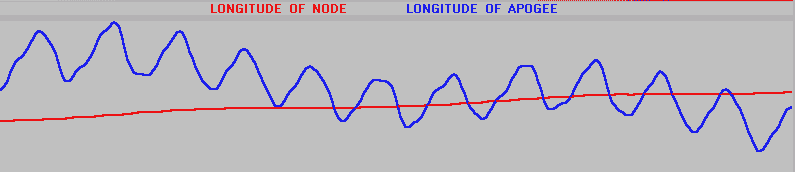
Node/Apogee 29Ta25 29Ta25 2452794.6657 4/ 6/2003 3h58.6
Node/Apogee 29Ta25 29Ta25 2452804.2594 13/ 6/2003 18h13.5
Node/Apogee 28Ta38 28Ta38 2452823.9266 3/ 7/2003 10h14.4
Node/Apogee 27Ta50 27Ta50 2452837.3294 16/ 7/2003 19h54.3
Node/Apogee 26Ta15 26Ta15 2452856.0912 4/ 8/2003 14h11.3
Node/Apogee 24Ta52 24Ta52 2452868.7514 17/ 8/2003 6h02.1
Node/Apogee 23Ta04 23Ta04 2452890.6715 8/ 9/2003 4h06.9
Node/Apogee 22Ta04 22Ta04 2452903.3662 20/ 9/2003 20h47.4
Node/Apogee 20Ta52 20Ta52 2452921.2558 8/10/2003 18h08.4
Node/Apogee 20Ta31 20Ta31 2452936.6596 24/10/2003 3h49.9
Node/Apogee 20Ta27 20Ta27 2452950.2213 6/11/2003 17h18.6
Node/Apogee 20Ta22 20Ta22 2452972.1431 28/11/2003 15h26.1
Node/Apogee 20Ta23 20Ta23 2452977.2176 3/12/2003 17h13.4
In a period 6 months from June 2003 to December, the True Black Moon made 14 conjunctions with the lunar node. I have never understood why some people, seeing this, think that using the True Black Moon is “nonsense”. I think it is fantastic! Its transits are really obsessive/compulsive, like the symbolism attributed to it! (NOTE: it is common to see it transiting a natal point 19 or 20 times during a year).
VIII. The natural or “interpolated” apogee
If one compares the actual position of the Moon when it is at its apogee every 27 days, with the position of the “mean” apogee or Black Moon, the difference is never more than 5 degrees (actually -5.4 to +5.7), and the maximum is reached every 206 days. This has suggested to some people that the “true” position of the apogee must therefore describe a very smooth curve with an amplitude of 5 degrees only, in contrast to the very large 30 degree curve of the osculating apogee, which they describe as “unrealistic”.
The Swiss Ephemeris documentation mentions a proposal made by Henry Gouchon in “Dictionnaire Astrologique, Paris 1992”, based on a curve with an amplitude of 5 degrees. This solution is said to be “the most realistic of all so far”. It is also explained that the actual curve of the deviation between this Moon position at every apogee and the position of the mean apogee is not exactly a sine, and that Dieter Koch published a table in “Meridian” in 1995 “that pays regard to the fact that the motion does not precisely have the shape of a sine”.
In the long (and old) compilation of posts I wrote on the calculation of the Black Moon in my site, you will find those quotes and also a numerical formula I devised that demonstrates this (written 25 Nov 1999):
I calculated the times of all Lunar apogees from 2000 to 2010, a total of 136 apogees. I then calculate the positions of the Moon and of the mean apogee/Black Moon at those times, and the difference between the two. The difference oscillates between -5.4 to +5.7 degrees. When this difference is plotted on a graph, one sees a clear cycle with a period of 206 days. This is the period of the difference between the longitude of the Sun and the longitude of the mean apogee, and it shows that the main deviation in the longitude of the apogee is caused directly by the Sun. Let’s call the Sun/Apogee difference “A” = 197.1132 + 31931.756*T + 0.0106*T^2 (degrees) where T is centuries from J2000 = (Julian day-2451545)/36525. One can reduce the difference mentioned above (-5.4 to +5.7) to 1/4 or 1/5 of it, by adding the following correction to the mean apogee: -4.7 degrees * sine of (2*A). With this correction the errors will be less than 1 degree, and the maximum will be 2 degrees or less. If the difference were a perfect sine, the above formula would give the exact deviation of the position of the Moon at apogee and the position of the mean apogee. The remaining 1/4 or 1/5 means that the sine curve with a period of 206 days described will approximate the deviation with an error of 20 or 25%.
The main idea of this approach is to observe the position of the Moon when it is at apogee every anomalistic month (27 days). Its proponents use the positions of the Moon when it is at apogee as “the true apogee”, and to find where this “true apogee” is at other moments when the Moon is at any other point of its orbit away from apogee, they use a numerical interpolation formula, or in the most recent modification an adaptation of the classic analytic lunar theory based on trigonometric expansions, which is said results in smoother interpolated points.
Because this way of understanding the lunar apogee is based on the actual occurrences of lunar apogees in the natural world, I think the word “natural” describes it well. It is the most recent version of how to calculate the Black Moon.
When the apogee and the perigee are calculated this way, they are no longer an axis, and the difference between the perigee and its mean position can reach 25 degrees instead of only 5 degrees as in the case of the apogee.
This approach was described by Miguel García in 1997 in an article published in Spain (“Realidad y ficción astronómica de Lilith, Cuadernos de Investigación astrológica Mercurio-3, n° 6), who implemented its calculation in his software “Armon” (1997). It is also the approach of Dieter Koch, who together with Bernhard Rindgen published “Lilith und Priapus, die Schalen des Menschen” (Frankfurt 2000), with ephemerides of Lilith (the apogee) and Priapus (the perigee) from 1900 to 2010. Dieter’s work was awarded “the best astrological research result in 2000” by the Internationalen Astrologie-Weltkongress 2000 in Luzern (**information by Robert von Heeren).
Both the natural and the osculating apogee coincide at the time when the Moon reaches its apogee. One can say, therefore, that both are “true” only at that time, while at any other time they are an approximation. But there is an important difference: the osculating apogee is calculated rigorously from the geometry of an ellipse, while the natural apogee dismisses completely the idea of an ellipse (and of geometry), something evident in the fact that the apogee and the perigee do not form an axis.
Paradoxically, even though the proponents of the natural apogee reject the osculating value because of its very large divergence from the mean, the natural perigee can be almost as far away from the mean as the osculating value. The point sometimes called “Priapus” (the lunar perigee) is simply the point of opposition of the Black Moon in all the different ways of calculating it except one: the “natural” or intepolated apogee and perigee. This is because the interpolated apogee and perigee dispense with the idea of an ellipse, and is the reason why Astrodienst offers their position as a separate calculation. In all other cases the concept of “Priapus” is completely unnecessary and redundant because it symbolism is that of an opposition to the Black Moon.
It is the same with the north and south lunar nodes, in that Black Moon and “Priapus” are the 2 extreme points of one single axis. But there is something important involved here: if the Black Moon is conceived as the empty focus of the lunar orbit instead of as the apogee, then “Priapus” is meaningless and becomes simply the opposition point of the Black Moon, while the Black Moon cannot be considered an axis anymore, so the concept of “orbit” melts away.
Please note that if we dispense with the idea of an ellipse –as in the natural (=interpolated) alternative for calculating the Black Moon, then the concept of an “empty focus” tends to become meaningless astronomically, it “looses focus”, and an important part of the symbolism traditionally assigned to the Black Moon looses its “aliveness” and begins to fade. Likewise, if we establish the predominace of the symbolism of the empty focus (of the instantaneous or “osculating” ellipse –the true Black Moon) then the astrological meaning of the natural interpolated alternatives –based on the times of natural occurrence of apogee and perigee– begins to fade or loose focus.
The proponents of the natural apogee and perigee consistently disqualify the use of the osculating ellipse; however, this “interpolated” approach to the lunar apogee or Black Moon, based on past and future coordinate points instead of instantaneous positions and geometrical projections, represents a mixture of temporal planes and contradicts how all other radical astronomical points in an astrological chart are calculated.
IX. Riyal’s output
To compare Riyal’s accuracy (remember, in this case the positions can only be approximate by definition, especially in the case of the perigee), we will use sample outputs from the program “Armon 1.0” (1997) by Miguel García and “Ceres 1.17” (2001), by Dieter Koch. The sample is calculated for the 1st day of each month at 0h U.T.:
Armon Riyal Ceres
1 Feb 2000| 22Sa23 | 22Sa12 | 22Sa13 |
1 Mar 2000| 27Sa50 | 28Sa17 | 28Sa17 |
1 Apr 2000| 4Cp24 | 5Cp06 | 5Cp05 |
1 May 2000| 10Cp19 | 10Cp49 | 10Cp48 |
1 Jun 2000| 14Cp57 | 14Cp37 | 14Cp38 |
1 Jul 2000| 14Cp34 | 14Cp13 | 14Cp23 |
1 Aug 2000| 12Cp49 | 13Cp05 | 13Cp02 |
1 Sep 2000| 16Cp22 | 15Cp57 | 15Cp57 |
1 Oct 2000| 22Cp02 | 21Cp18 | 21Cp18 |
1 Nov 2000| 28Cp38 | 27Cp58 | 27Cp58 |
1 Dec 2000| 4Aq31 | 4Aq32 | 4Aq32 |
As you can see, the positions of Riyal are almost the same as those of Ceres. The most probable reason is that we were using the same algorithm. Originally, it was Dieter Koch who gave me the suggestion about how to calculate it when I implemented it in Riyal in November of 1999. The perigee shows larger discrepancies…
Table 2.- natural or “interpolated” perigee:
Armon Riyal Ceres
1 Jan 2000| 1Ca23 | 1Ca35 | 1Ca37 |
1 Feb 2000| 16Ca38 | 17Ca44 | 17Ca23 |
1 Mar 2000| 22Ca41 | 24Ca02 | 24Ca05 |
1 Apr 2000| 17Ge54 | 23Ge53 | 19Ge45 |
1 May 2000| 14Ge01 | 13Ge50 | 14Ge53 |
1 Jun 2000| 26Ge14 | 26Ge52 | 26Ge49 |
1 Jul 2000| 11Ca37 | 11Ca39 | 11Ca38 |
1 Aug 2000| 27Ca35 | 27Ca14 | 27Ca16 |
1 Sep 2000| 11Le31 | 11Le26 | 10Le40 |
1 Oct 2000| 15Le17 | 10Le39 | 14Le00 |
1 Nov 2000| 8Ca13 | 10Ca43 | 6Ca39 |
1 Dec 2000| 8Ca47 | 6Ca41 | 7Ca51 |
In this case, the discrepancies are larger between the 3 programs, probably because different algorithms are being used. (Details of Riyal’s algorithm are given in the program’s documentation.). Since there is no way of obtaining high accuracy in this case, it is very difficult to know which positions are more accurate or “correct”.
Riyal is FREEWARE. It can be downloaded here.